Showing posts with label varanasi. Show all posts

Thursday, February 2, 2012

of circles and lives


sunrise on the Ganges
Varanasi is a place that gleams. It gleams at night, when the lamps on the ghats cast their soft impressions upon the rolling waves of the Ganga. It gleams at noon as the sharp rays of the sun reflect onto the eyes of a careless onlooker. And it gleams at dawn and twilight with colours that would make a mixed palette left to fade in an artist’s workshop. The splash of lights and colours in its busy markets and in the rows of shops that line the ghats reflect upon the people who flock to this bustling town every day. The rail link between Mughal Sarai and Varanasi, opened in 1862 and the rail-cum-road bridge across the Ganga which was opened in 1887, made sure that this famous ancient town of worship was more accessible for visitors from across the region.
Today, Varanasi is nothing like it was when its first railway station made mass transit a realisable dream for many. Varanasi today, like many other famous small towns and cities in South Asia, is facing a continuous friction between the ‘new’ and the ‘old’.  Someone who has lived and grown up in the pre-colonial localities of Delhi and Lucknow may well be able to sympathise with Varanasi on several different grounds. As the cramped and narrow gullies of Old Varanasi, home to the silk workshops of many famous Muslim weavers of the Julaha caste, contend with the issues of livelihood, a few miles away lie extremely posh residential areas which are seemingly oblivious to the hundred and forty thousand strong slum population in the city.
Dashashwamedh Ghat in Varanasi
With a deep location within the historical development of the various distinctive Hindu, Muslim, Buddhist and Jain traditions in South Asia, Varanasi is a microcosm in its own right. The Dashashwamedh Ghat, supposedly named after Brahma’s sacrifice of ten sacred horses, is a household name with anyone who is fond of the city. A stone’s throw away from the gilded facade of the massive Kashi Wishwanath Temple, this ghat is witness to a lengthy ritual worship of the Sun god and the god Shiva every evening which attracts devotees and tourists in hordes. Spectacular displays with fire light up the face of the river as the drone of the chanting makes everything else inaudible, taking everyone in its wake as the ceremony progresses. The acclaimed film maker Satyajit Ray made these riverside ritual gatherings part of his subject in the famous film based on his equally famous detective novel, Joi Baba Felunath, which brought out the sinister as well as the beautiful around these ritual practices in Varanasi.
The other equally famous ghat in Varanasi is the Manikarnika Ghat, a site for ritual cremations on funeral pyres. Mostly done with sandalwood, hundreds of dead bodies are lined up at the ghat for cremation. Broadly, the Dom caste, which is traditionally an untouchable caste, is responsible for dealing with all that is deathly in dominant Hindu society. It is in Varanasi that this form of oppressive and stigmatised division of labour has perhaps also given Doms a visible prominence, as the ritual order considers working with dead bodies a polluting act and hence needs the Doms. This has also led to the famous titular role of the Dom Raja in Varanasi while at the same it has also meant that the caste-marked livelihoods of many depend on sifting through the ashes of dead bodies in search for precious ornaments like rings or even gold teeth as well as discreetly re-selling ornamental funeral shrouds which are otherwise meant to be specific to each funeral. Beyond Manikarnika ghat lies the Harishchandra Ghat, which is a similar site but is used by families which can’t afford expensive sandalwood. Together, these two ghats hold the term, the ‘burning ghats’, as the funeral pyres are forever burning, a sombre sight on the breezy dark nights along the Ganga in Varanasi. 
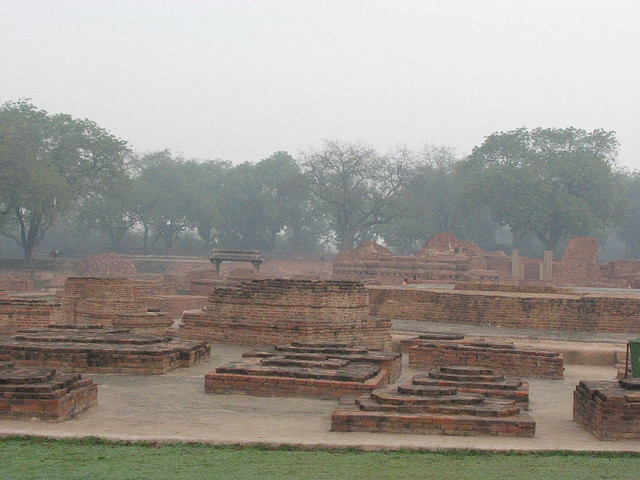
the ruins at Sarnath
Within the Buddhist tradition, Varanasi occupies an equal place alongside Lumbini and Bodh Gaya and is a stone’s throw away from the deer park at Sarnath. Buddhists from Sri Lanka and Indonesia regularly visit the city which has also led to the national airlines of these countries to designate weekly direct flights to the newly built international airport outside Varanasi. The Chaukhandi stupa, a short ride away from Varanasi, is a dominating structure atop a huge burial mound. Its previous architecture from the Gupta period has also been modified under the rule of the Mughal emperor Humayun and stands testimony to the many transformations of religious life in the last millennium in South Asia.
Piety has many faces in Varanasi and it would be naive to assume that it is all there is. The city’s many realities are tested against this image time and again and travellers in search for the many-sided and complicated facets of cities would find a lot of food for thought in Varanasi. This city’s immigrant foreign population, much of which is composed of Israeli Jews or residents of the C.I.S states and Eastern Europe, work as yoga assistants or as voluntary labourers in different Ashrams, drive rickshaws or participate in sex work. The impious in the holy city of Varanasi are patrons of non-Indian sex workers, wholly aware of the fetishism of ‘white’ women. These and many other paradoxes are the complicated reality of many cities in the world, to which Varanasi is no exception. While it is important to critically see through the many facades of the city and question its many representations without harbouring prejudiced judgement, it is also important to understand how these differences exist together and against each other, producing a fuller travelling experience.
a poster advertising Ustad Bismillah Khan
Varanasi’s famous silk sarees, known world over for their intricate embroidery and weaving, along with its famous silver ornaments and other metal work is an understated attraction. The weaving process of the Benarasi Silk sarees is a long and arduous one which makes each sari a unique one. Add to that the delicious cuisine of Old Varanasi, most popular during the festivals of Budh Purnima, Maha Shivratri and the Ram Leela, and there is a treat at hand for all the senses as well as the mind. To top it all off, a Banarsi paan (sweetmeats wrapped in betel leaf) and a Bhaang Thandaai (flavoured cannabis-laced cold milk shake) after the meal would make it an experience like none other.
Varanasi has produced many stories. Its voice has been heard across miles of land and sea through those who have spoken of its depths or sung of its beauties. If you have been spellbound by the late Ustad Bismillah Khan playing the Raag Maalkauns on his famous shehnai at the Queen Elizabeth Hall in London, then you would love to see the city where it all began. If you haven’t done either, make the trip anyway – you’ll hear the brilliant shehnai renditions at the Kashi Wishwanath Temple every evening. It is where the great Ustad started off as well.  

Monday, November 14, 2011

Of idyllic landscapes and slow boats on the Ganges


a few boats for fishing
Inspired by Paul Robeson’s Ol’ Man Mississippi, the late Bhupen Hazarika’s most famous legacy is his ballad to the Ganga as being a faithful observer to the paradigmatic changes that take place around it and about it. His passionate appeal to the Ganga to not remain a static observer to the degradation of humanity around it engenders a pathos to the idea of this might river. But the Ganga is no mere observer, as many would argue, that rivers have an organic economy of their own that come into being in the interaction of people around the river with it. This relation often serves to keep the sustainability and coexistence of man with nature within the horizons of the people whose lives depend on the river. Sailing down the length of the Ganga is one way of discovering what it means to live with the river and depend on it for livelihood for years and yet repeatedly find newer facets to its unparalleled beauty.

Beginning from Sitamarhi, near the Prayag at Allahabad, there is a noticeable calmness to the river as we set sail towards the famed meeting point of the Ganga and the Yamuna. The water bears the distinct difference in colour as the soft brown of the Yamuna seems to melt into the thick blue of the Ganga. Devotees take their ritualistic dips and my shutterbug hands are abuzz in the early morning sun. The river offers many beautiful sights to capture, all of which seem to be ensconced within a heavy silence. This reverie breaks as the boat nears any local ghat or other sets of habitations but as the boats meander through the spine of the river, it is the silence of one’s own surrounding that marks a great distance with the madding crowd. 

local sights of Bitthauli
We stop at Bitthauli ghat once to have a look at the local markets and the daily humdrum of a riverside village. Boatmen, fishermen and fisherwomen move in and out of the narrow lanes, stopping at the ghat for some work or the other. Ferries transport people from one bank to the other and rickshaws queued up call out to them loudly. Subdued vitality greets one at the entrance of the fishing village. Customers like their bargains as much as they like their fish and a quick snack while you breathe it all in makes this stop worthwhile.

We travel in one boat while a kitchen boat follows in its wake. Equipped with mattresses, a gas cylinder and a cooking stove, the boat is minimalistic and palatable for the simple traveller. As the day unfolds, the river grows increasingly broad and equally silent, allowing the call of white gulls and the drone of the boat to lull me into sleep. One look around though, makes one sharply aware of the lack of the famous Gangetic River Dolphin, referred to by many colloquial terms, the most common of them being ‘shushuk’. This one species has perhaps been the worst affected by the kind of industrial growth around the river. Polluting factories are known to dump industrial waste without strong pollution checks into the body of the river. Add to that the annual round of Hindu festivals and the daily ritualistic practices at holy Hindu sites like Varanasi and Allahabad that contribute massive amounts of ash, wood, dead organic substances as well as untreated human waste leading to rapid degradation of freshwater life in the Ganga

Besides the fall in population of the dolphin due to deaths, the other reason for fewer dolphins is their gradual movement away from the main river body in to smaller tributaries and distributaries. But they face many threats there as well since these are muddy patches with lesser water flow and the risks of getting caught by fishermen is quite high. News reports of dolphins washed up along smaller river banks were not rare in the last few years but were mostly ignored by state authorities.

sunset from the Chunar Fort
These thoughts are pleasantly interrupted by the arrival at Chunar fort. The fort has a tempestuous history – a site of rebellion as well as authority given that it is positioned close to where the Ganga turns southward to continue to its delta. The fort served as a crucial river port and an important frontier location for the Mughal Empire as well as its contemporary rulers such as Sher Shah and Hemu and subsequently went on to become an East India Company holding under William Hastings. The fort’s wide hallways and wells grab my attention and as I walk past stone railings, I can’t help but notice the elaborate network of staircases within the fort. The Ganga flows past the walls of the fort and when the boat pushes back into the river, the boldness of stone architecture again gives way to the silence of the river.

We camp on riverine islands near Chunar, resembling large sand banks which are largely uninhabited. These are mostly resting points fishing boats which stay overnight in the river. The boatman’s wise quips about this river’s multifarious stories and the smell of cooking from the kitchen boat fill up the void left by the milling crowds of Chunar and the world beyond. The fish our boatman caught in the river, all fresh, has now been nicely cooked and adequately relished. By nightfall, from inside our small pitched tents, the river doesn’t look like one anymore. It feels more gigantic, more sea-like. And it is with that image that one can tuck in, the rising tide gently pushing up the nearest bank.

the Ramnagar Fort near Varanasi
The morning is a far cry from the dewy sunlit ones back home. I see the vast expanse of the river island in front of me and the sun at its other end, staring me in the eyes. The Ganga mildly dazzles in the reflected rays of the yellow sun and after munching on some quick breakfast and a visit to the “washroom tent”, we head on to Ramnagar. We reach the Ramnagar fort by early afternoon after some comfortable sailing and this time, a busier ghat awaits us. Home to the royal family of Varanasi, the massive sandstone structure looks intimidating against the bottle green of the river. An afternoon stroll through the lawns of the riverside fort followed by a quiet seat next to the ghat while the evening aarti takes place, a few minutes away from the hustle of the Varanasi ghats, and there is sense of completeness to this river ride. Pottery markets and other craft markets are abundant in the area and a lengthy effort at finding the best in there is what must follow such an invigorating experience.

Saturday, February 26, 2011

When all thats gold, glitters


It is amazing how a city can surprise you when you do not expect much from it. On an otherwise regular journey that comprised of Agra, Varanasi and Dharamsala, we expected to be awed every time we went somewhere. The Taj was expected to be the Taj. Varanasi was expected to be excellent for photo-ops and Dharamsala was expected to be what it was. However, on this journey of comparative religion, we had quite a surprise waiting for us.

The evening Arti in Varanasi. Image Courtesy: Ann Raets
I have never been a great fan of religion. I was never quite keen or quite against it. To each his own. And to me, religion was more of a subject than something that I could actually follow. Moreover, in a country with 6 major religions and a million minor traditions, you would have to forgive my skepticism towards elaborate rituals that are more a show of wealth than a show of faith. Faith itself is hidden somewhere deep inside.

In this aspect, Varanasi itself is quite interesting. Although quite cliched, I have found Varanasi to be quite a fascinating collage every time I have visited the old city. Moreover, taking the boat down the ganges, I see Hinduism for what it really is – a way of life. The fact that it is meant to be this way makes me both proud and ashamed – proud of the fact that such a concept exists, and ashamed of the fact that those in power had twisted it to its current avatar just to suit their profits. Apart from this, it is amazing to see how life revolves and bows down to a river. Maybe Varanasi is one of the few cities to pay homage to something that is so essential. Most great cities are built around a river or a major water source. But most cities have quite forgotten where their water comes from or used to come from. Varanasi is one of the few cities that acknowledges and prays to this fact – and does nothing about it.

From Varanasi we had moved on to Agra and then Amritsar. We had not really expected much from Amritsar. Apart from the symbol or Sikhism, it is not supposed to have much. It does have a symbol of the freedom struggle. But the freedom struggle was in the last century. We have almost forgotten and taken our freedom for granted. Like most places of worship, I had already forecasted what I would see.

Or so I thought. For the Golden Temple is a different world on its own. Gone is the feeling that there are wars going on in some parts of the world. Gone is the memory of the petty squables that we had considered insulting. Gone is the rage that we felt during traffic hours. Gone is the greed we felt when we asked for the salary hike. This was something else altogether – and if I may say so, the closest definition to the divine.

The Golden Temple, Amritsar
The first thing that strikes you is the absence of elaborate shows of faith. Apart from the basic courtesies, everyone prays in the way he or she would like. Some take a dip in the holy water. Some stand in queue to see the holy book. Others just note down the teaching of the day. All that you see are men laughing, women helping the children, people praying in silence and occasionally, the priests reciting verses from the book. The elements of faith to be followed are of one's personal concern and do not need to be shown to others. The people did not jostle for one more minute at the shrines. They did not get any special treatment on account of their wealth. They did not believe in such things. Instead, they went about doing whatever the eye-in-the-sky meant them to do. In a large dining room serving 50000 people a day, you could see people from all walks of life serving and eating. Physically old and mentally young, newlyweds and old couples, the rich and the poor, everyone did his bit to serve food to the other person. Everyone sat on the ground and next to each other. Anyone peeled the vegetables. Anyone cooked the dal or boiled the rice. Anyone made the tea. It was as if “class” had suddenly lost all meaning or reason for existence.

While we were leaving for Dharamsala, my friend told me that it is an amazing feeling to sit there with your eyes closed for 10 minutes and listen to everything around you. He said that he had felt quite at peace after that. Unfortunately, I missed out on that. But it was already quite baffling. The fact that there could be such a utopian practice did not baffle me as much as the fact that such a utopian practice was so simple. Gold itself, seemed to be so crystal clear and simple.