Showing posts with label Indebo. Show all posts

Tuesday, August 21, 2012

We Took a Break.

So, remember how we told you how much we love travelling at Indebo? Well, this time we took all that love one notch up – we decided to put together a trip for all our staff at the office. Following a lot of arguments, we figured the one place where such a large group could peacefully relax and let their hair down could only be Kerala. It’s the Malabar, after all – blue water and blue skies, that is, if you manage to see past the deep green foliage above your head, and a significantly relaxing cultural atmosphere. By the time we set off from Delhi, everyone was basically looking forward to some delicious food, some simple travelling and a lot of bonding.

At first glance, the first day of the itinerary looked simple – getting  off the flight at ten, with the next  four hours earmarked as “local sightseeing around Cochin”, following which would be a lavish lunch. Only, that wasn’t entirely accurate – it came with a twist! Once everyone was out of the airport, they were handed an envelope each. A solitary card inside carried the name of a spice – the Malabar was also spice country, after all!

Historically speaking, it is practical knowledge for Malabari chefs – want some spices, get to Alleppey! Anyway, the ones who got the same ‘spice card’ then made a team – so we had six in all. Garam Masala, Red Chillies, Bay leaves, Yellow Turmeric, Green Cardamom and Black Pepper – our six teams then got into their coaches which dropped them off at different points around the city with one line of a clue each.

Indebo Staff at Cochin Airport
Yes, this was the madness behind the innocent itinerary! Inspired by the popular show ‘The Amazing Race’, our organising team had decided to put together a hunt of our own. Within the hour, there were six groups of Indebo staffers chasing down clues across Cochin – clues included everything and anything historical. From one of the oldest churches in the countries (Santa Cruz), sari weavers in Ernakulam district, the famous Cochin Synagogue and one of the oldest gold craft showrooms – clues were scattered everywhere that required the teams to fish deep and think hard. While some searched for the guide who held the next clue at Santa Cruz, others decided to talk to the salesmen and craftsmen in order to scoop out the other clues.

By the time all the clues were discovered, the last of which was the same for everyone – the link to the place where lunch was scheduled – it was the Green Cardamom team led by Ibotombi Singh that had emerged the clear winner. As the rest of the teams trooped in slowly, signs of the gruelling challenge showing on their faces, a large container of Biryani was brought in to be plated. Both relief and satisfaction lined everyone’s face. And based on the responses we got to a review questionnaire after the trip, this meal was rated as the best – not just because it was simply outstanding but because the treasure hunt had made sure everyone was hungry enough to love each and every bit of the lunch.

Indebo Staff at Kathakali performance
That evening, at Casino hotel, all the ladies were handed saris and the men were given mundus – both traditional pieces of Malayali clothing which was also our own dress code for the Kathakali performance scheduled at Fort Kochin at night. The expected unease with such traditional clothing from people mostly used to western formal wear was nowhere to be seen – everyone seemed to be in the mood for challenges and they pulled the garments off in style. Their grace took our hosts completely by surprise – at the Kathakali auditorium, the manager actually asked how many of us were from Kerala itself. He couldn’t believe the answer!

Everyone got a short lesson on make-up art before a Kathakali performance, one of the most crucial ingredients that requires an exceptionally firm and artistic hand. The performance itself was followed by dinner at the Brunton Boatyard – a fabulous place right next to the sea. Given all this activity, we were sincerely hoping the excitement didn’t wear off by the next day – and we were pleasantly surprised.

Everyone seemed ready for another go by breakfast next morning – and this time our destination was Vaikom and Kumarakom. We stopped to take a walk through the large yard and lawns at the famous Sree Mahadeva temple on the way before splitting up into two teams – this time, for sharing time between the activities planned for the day. So while one group went off to learn about coir making and coconut processing, the other got canoe rides through the backwaters, taking notes on fishing and toddy-tapping. A couple of hours later, the groups switched amidst excited conversations about tasting local toddy and shopping for coir handicrafts.

Lunch was scheduled at the village residence of one of Indebo’s oldest associates in Kerala – the meal, served on banana leaves, included all kinds of Malayali delicacies, topped off with generous portions of banana fritters. Needless to say, this meal came a close second on the best meal question in our official review. We spent that night at the beautiful Coconut Lagoon resort, after watching the sunset on the backwaters from the roof of a houseboat on Vembanad Lake. This short cruise got everyone in the mood for more time on the lagoons the following day.

Vembanad Lake is part of a cosy waterway leading to Muhama – so we set off next morning on a luxurious houseboat along the waterway. The smell of spices floated off from the villages lining the waterway and we had cheerful exchanges with school kids on holiday who were lazing by the banks – in India, curious travellers always give kids a reason to share a joke or two, followed by splits of uncontrollable giggles!

Serene Lands of Alleppey
By early afternoon, we had finished off a sumptuous meal on the houseboat and landed near Alleppey. Since the evening was free, many took off to shop immediately – from banana chips, sarees, trinkets and nuts to the conspicuously huge umbrellas and school bags, everyone had an interesting selection of purchases. The bout of shopaholism soon gave way to beach chairs at Marari beach resort – a luxury that no one had in the last two days.

Before dinner, we had scheduled another exceptional performance – Kunchan Nambiyar’s legendary compositions as an Ottam Thullal. The other two types of the Thullal are the Seethankan Thullal and Parayan Thullal. While most didn’t understand the Malayalam poetry, the element of satire and ridicule was lost on none – Nambiyar’s excellence as a popular poet revealed itself through the performance as the fourth wall was made to seem like a nonexistent category – the dancer made different parts of the whole auditorium a prop to his art. From the intermittent swearing and the lyrical exposition, there was everything that Ottam Thullal is known for. Such was the energy in the performance that even the audience’s laughter became an accessory for the dancer on various occasions. Memorable wouldn’t even begin to describe the evening – no one could stop talking about it even after dinner.

Next morning was our last day in Kerala. So we decided to pick up bicycles and ride through the famous fishing villages near Mararikulam. Those who weren’t bicycle enthusiasts decided to either laze by the swimming pool or take a wonderful Heritage Walk. This heritage walk was organised by the Ladies’ Wing of the local chapter of the Lion’s Club. Under the banner of ‘Preserve Alleppey’, Mrs. Rani John works with other members to archive and preserve the oldest buildings in the town and promote cleaner streets and neighbourhoods. The Walk included both small and big aspects of the town – from coir-making units and churches to heritage buildings made from stone imported from Surat in Gujarat during the heyday of Gujarati mercantilism in the region.

By the evening, we had even managed to find people enthusiastic for a yoga session with a well known yoga practitioner – the whole day seemed to be about rejuvenation. But our excitement was yet to come undone – there were still some plans left to be unpacked. Mr. Verghese, the Administrative head at our office in Delhi was given a birthday party that took him completely by surprise! While he was summoned by our Managing Director under the pretext of official work, our office team put together a lavish party, complete with party hats and masks – leaving Mr. Verghese to find himself in the middle of a surprise carnival in his honour. The party was also an occasion to give away awards to the team that won our crazy Amazing Race which was then followed up with yet another surprise! Most people felt that it was unfair that Rajesh had to be away on this staff trip on the day of his wedding anniversary – dedicated that he is to his work; we figured it would be momentous if we celebrated his anniversary with him! Rajesh couldn’t believe his eyes when he saw what everyone had got him – a model replica of a famous houseboat with white sails from the workshops along the backwaters in Alleppey.

The drive to the airport at Cochin next morning was a sleepy one. High and dry after the previous night, there were a lot of good dreams to have in the days to come. Such is the nature of the travel bug – it leaves for a while, only to return again with something more novel than the last time.

Monday, August 6, 2012

Self Driving in the Himalayan Range


It’s not the first thing you think of when you think – India. In fact, it may not even be amongst the first ten things you think of. And yet, there are those who love it and devotedly look forward to it in India. No, we’re not talking about snowfall! We’re talking about self-driving across the subcontinent.
Not the American way – with trailers and a thousand miles of black road, shimmering in the sun! Here, we take SUVs and pack off across several kinds of roads – the dirt, the stony, and the wet and yes, the shimmering strip of metalled black. To give you a short glimpse into what we’re talking about, we decided to write about our last self-driving trip that began at Shimla and meandered its way through Spiti valley to finally culminate in Leh, the nerve centre of Ladakh.
Self-driving is an extremely rare indulgence in India owing to the technicalities involved – in today’s travel industry, we remain a leading customised service provider for this form of leisure travel. Here’s what it takes for a visitor to take a car and explore the country on their own – a specific vehicle that’s either a 4x4 or a 4x2, depending on road conditions, that comes with an exclusive 1N – yellow tinted number plate. We add several other features to the setup – for starters, a state of the art walkie-talkie communicator for driving in regions without telecommunications access, backpacks fitted with oxygen cylinders for extremely high altitudes (especially necessary if one leaves the vehicles at a certain point and chooses to trek or ride a bike for some distance), and a substitute driver from our company who can step in for you in case the fatigue seeps in. Before beginning, however, there are several mandatory procedures that need completing – since cars have certain components which are non-insurable (e.g. headlamps), a set of pictures of the car are attested to by all parties at the time that the cars are handed over which is then followed by a complementary demonstration on driving ethics and rules in India.
After we had put all these things out of the way, the bunch of driving enthusiasts decided to step on it. Driving for about 6 hours every day, the set of six vehicles reached the banks of the Sutlej, after passing through Narkanda and a mandatory halt at Reckong Peo, and stopped for two nights at Kalpa – at a lodge nestled within sprawling apple orchards. The mythological cosmos of the town is humbling – while many would suggest waiting to watch the tip of the Kinnaur Kailash (a mountain in the Kinnaur hills that resembles the Mt. Kailash) change colour with the ebb of sunlight, others would find deep meaning in sitting with the chanting monks in the evening. In ways both visible and imperceptible, both Hindu and Buddhist thought have arrived at a confluence of sorts in Kalpa.
Our next stop was at Nako monastery in the tiny town of Nako – another small but symbolically relevant stop in this part of the Himalayas. At Nako, beyond the soaring willows, lies the mystic Nako Lake – believed to be a site where the Guru Padmasambhava pronounced several principles of Tibetan Buddhist faith. For Buddhists, the site remains one of mystery and belief – even the caves in the hills surrounding the lake are believed to be places where great penance and meditation gave way to great knowledge. The road from here went further up the altitude towards Kaza – a route that is lined with famous monasteries like the Tabo monastery and the Dhankar Gompa.
At Kaza, for the first time perhaps, can one find comfortable lodgings – given the nature of the terrain and the niche popularity of self-driving and biking in the subcontinent, most lodges in region provide bare minimum services which are a far cry from the comfort of more popular tourist destinations. To travel here, and especially to drive in these mountains, the discerning traveller must look to both love the excitement of the terrain as well as persevere with it.
The Banjara Retreat at Kaza gave our eager drivers some time to unwind – hot water bags found their way into beds and time seemed to slow down with the hot shower baths. With some fresh dinner, everyone took to the night since the next morning was going to be another long day of driving. The road to Jispa goes through the Kunzum pass – the mouth of the beauteous Spiti Valley –which means that the highest altitude along the road could go up to 4555 meters before descending to about 3142 meters at Jispa. There is the option of taking a slight detour to Chandra Tal – the celebrated lake, famous for its still reflections of the moon on a full moon night, which rises out of water from a hidden underground source and lends its banks to campers every year, from all parts of the world.
The Padma Lodge at Jispa has both tents and buildings to house its guests – with the Bhaga River flowing right by it, we decided to take a day off to simply soak our feet in the river, walk on the river bed and try and catch some fish. We followed this up with taking a walk through the town and the nearby villages in order to get a sense of what life is like here – with scarce supplies of many essential goods and a lack of diverse vegetation. Taking to the road once again, this time we headed straight for Leh via Sarchu, with drivers taking turns at the wheel.
Leh brings to memory everything cold – its climate marks it out as one of the rarest such terrains in the world. Our driving enthusiasts, after a couple of days of acclimatisation, decided to ride higher up into the Himalayas, on our Royal Enfield bikes, to the picturesque Nubra valley. After stocking up sufficient water and food, we took the Khardung La pass, riding along the banks of the Shyok River, to enjoy the cosmic splendour of a silent desert at 10,000 feet above sea level. A visit to the looming Maitreya Buddha statue was followed by some more mountain biking. The Nubra Valley is home to one of the rarest animals on earth – the Bactrian camel – and we even managed to arrange a ride atop these unruffled beasts.
Once back in Leh, part of the group decided to take the route south to Sokar village – tucked away inside Rajauri, this village is gradually gaining a reputation for being a great camping spot. We provided tents to the campers – what followed was a couple of nights of revelry with no one but ourselves around. This journey opened up, for us, a number of stimulating ideas – self driving allows a degree of freedom that other forms of travel don’t. Enthused into making more creative itineraries using unexplored cultural destinations along these routes, our team is now on the prowl.
Since regulations on self-driving in India require specific marked vehicles which are only available in Delhi, Bombay and Bangalore, we’ve decided to open up all these regions to exciting self-drive options. In the coming weeks, we’ll be taking the road from Jaipur to Jaisalmer in Rajasthan and the scenic Konkan route from Bombay to Goa and onwards to the Nilgiri hills. So, if your heart’s racing already, you know where to find us.

Wednesday, May 30, 2012

With the Thunder Dragon I


a regular sight in bhutan
Bhutan has been described as many things, from the scenic to the authoritarian. It has been made out to be the last “Shangri-La” in different representations by a cross-section of writers, commentators and film-makers. Those who are too taken by its natural beauty and splendour find it an “unspoiled kingdom” while others lament its lack of openness and freedoms given the overarching presence of Buddhist religious life. But this bind, we find, is a rather troubling one. Bhutan for us, replete in its beauty is also a land with its own complexities which cannot be simply wished away or be fossilised in a romantic antique frame. Let’s take one example of the diversity and difference that gets hidden in the romanticised narratives of Bhutan - Its languages and dialects are aplenty although the average version you’ll get is that all Bhutanese people speak Dzongkha. Languages like Lakha, Brokkat, Bumthangkha, Olekha, Chalikha, Tshangla and Brokpakhe and many others often get overlooked as Dzongkha is promoted as the national language.
The example of language is just one way in which we absorbed the overwhelming experience that is Bhutan. Our travels through Bhutan, from the Valley of Ha in the west all the way to its South Eastern borders, brought us face to face with many of the different realities in Bhutan. The valley of Ha is mostly a flat terrain irrigated by the Ha Chu River and it is here that one first realises that the broad assortment of deities in Bhutanese rural life stretches much beyond the formal and more visible Buddhist ones. One of the most famous deities in western Bhutan is the Jichu Drake, the resident deity of the massive mountain with the same name. A hike to Chele La will give anyone a spectacular view of the Jhomolhari and the Jichu Drake. Like most other great natural formations like rivers, aged trees and overgrown medicinal plants, mountains are often treated as local deities. In some cases, these deities and their singular mythical tales have been woven into the narrative of the rise in Buddhism in Tibet but in most others, they remain distinct in their presence within the stories of local village communities and sometimes even the whole valley.
prayer flags on the roadside
The rise of Buddhism in Bhutan in the last millennium is also a story of the gradual overpowering of local deities. Almost every other mythic tale that we encountered around Guru Rinpoche, the young monk said to have schooled at Nalanda and learnt his scriptures in Tibet and then brought Buddhism to Bhutan, is a tale of vanquishing undesirable local deities. Over time, Padmasambahava, as Rinpoche is ritually known, acquired a status that is second only to the Buddha in Bhutanese formal religion. Myths of different monks subduing diverse local deities who were always either too frivolous or unpredictable or unreliable lasted much beyond the Rinpoche stories themselves, as we carefully discovered, and are now part of the official narratives of Bhutan’s history. What was most heartening was that these stories of vanquished local deities did not entirely erase their presence. In terms of how fondly they are held in local cultures, we found many to be quite alive and present just like the formal Buddhist deities, although they are not as popular.
It is in Ha that we witnessed our first local archery tournament. The sport that most men play in Bhutan is also a catalyst for great social interaction. Two teams of thirteen players each battle over a strip of four hundred and sixty feet with each archer getting two shots per round. The teams had their own families and friends and other locals supporting them. The groups of supporters and fans often tried to sledge the other team and pass hilarious comments on missed shots and faulty postures of the members of the opposing team. Intermittent shows of local dances and the regular call of hawkers selling different snacks to the spectators entertained us thoroughly, a lovely distraction from the noise that accompanies cricket matches back home. Some of the dances are also ritualistic ones which are performed on other occasions for different spirits and deities.
an archery match in progress
To help you get a hang of the broad nomenclature, here is our small reference list – ‘Lu’ are mostly aquatic deities residing in the abundant water bodies in Bhutan, ‘Nyen’ are the deities of trees, ‘Tsen’ are the spirits of rocks and mountains and ‘Za’, the deities of different stars and planets. Together, they form a cosmology of faith that is quite complex. One small example of this complexity is the free flowing sexual humour associated with these archery tournaments. The wild and contagious laughter from both men and women that followed someone yelling at their favourite archer in the tournament - “Get that shot right or you will have many lonely nights in bed” – told us that all the religious symbolism around us didn’t quite create an atmosphere of formal tight-lipped reverence. The spirit of the ‘popular’ was well and alive in this case.
We hiked from there to the Taksang Dzong, otherwise called the Tiger’s nest, redone completely after it was burnt, most recently, in a fire in 1997. The hike up the hill slowly unfolds along the way, the spectacular beauty of this dzong, its dusty yellow and white facade shimmering atop a 3000 feet high cliff. Dzongs are like fortresses which also perform important religious functions. Each valley has its own dzong which is the central seat of most annual events. Festivals in Bhutan are placed around a yearly calendar, which depends on the date which the highest authority of monks in the Kagyu order, patronised by the state, decide to announce as the first date of the year. The other dominant order is the Nyingma order, which allows laypersons to perform rituals and is not as strongly hierarchical as the Kagyu Buddhists.
A jeep ride to the famous Punakha Dzong, standing atop the confluence of the scenic rivers Po Chu and Mo Chu, was our next plan. The oldest dzong in the country, this trip brought us face to face with the seat of Buddhist tradition in Bhutan for the last five centuries. The six storey tower dominates the skyline and within it holds massive golden statues of the Buddha, the Guru Rinpoche and the Shabdrung Ngawang Namgyal, the ruler who built the Punakha dzong and assigned it as the winter capital of Bhutan. Its original sixteenth century structure has been modified over the years, the most notable one being the two cantilever bridges across the rivers leading to the Dzong. From the doors of the dzong, we walked barefoot to the edge of the waters and sat there for what seemed like hours. Time didn’t seem to catch up with the tide of the rivers at Punakha.
We left Punakha for the Trongsa dzong, another extremely intricate structure, knowing that we had just made half our way from the west of Bhutan towards its eastern borders. And as the green and blue became a speeding haze of colour against our car windows, Bhutan seemed much more familiar than when we had first set foot in Ha.

Tuesday, March 20, 2012

great escapes and tiny islands


sometimes you dont need photoshop
Imagine a dot on a map. Imagine a handful surrounding it. Then fill the rest with sparkling blue and keep some green for when you get closer. That, in short, is the stunning aerial view of the famous Lakshadweep Islands, off the coast of Kerala, nestled in the expansive Indian Ocean. It is a universe on its own with coconut and palm trees as the dominant inhabitants, making humans look like small fry. This least populated territory within the Indian Union contributes the highest share in production of coconut and coconut-based products. This and several other reasons make the Lakshadweep islands our focus of the month. 

Accessible by both water and air, these set of islands have become favourable travelling destinations in the last few years. While regular boats and steamers operate from the port at Kochi, the island of Agatti has an air strip which facilitates air travel from the Kochi airport. Recently opened resorts and an established infrastructure for water sports and marine study make any itinerary extremely exciting. 

scuba diving in Lakshadweep
In terms of depth, both literal and more abstract, any discerning traveller would have a feast. While snorkelling and diving can mark half the itinerary, there is a host of learning in store in the enthused fishing villages that could take up most of your time. But before much of that, there is a sense of pristine physical beauty that needs imbibing. Lakshadweep is a set of atolls, a rare geographic occurrence wherein a lagoon of sea water is either partially or completely surrounded by a coral reef. Atolls are only seen in tropical and sub-tropical climate and offer an opportunity to study diverse forms of marine flora and fauna. Once the general singularity of these island formations is clear, a lot of natural phenomenon can be understood such as fishing seasons, fishing techniques, land mass formation and biospheric interactions. 

The islands have been historically quite eventful, from the Pallava and Chera kingdoms when it was an essential outpost for coconut trade and naval control to the modern day Indian state, where it holds similar relevance. Cultural similarities to Kerala are present in terms of language and local customs but those have significantly transformed in relation to the surrounding environment. Diversity within the islands is also an interesting facet for curious travellers – the variety of dances like the ‘Lava’ and the ‘Kolkali’ and the fascinating spatial organisation of villages according to organic norms of sustainability. Access to the islands is regulated via permits by the Indian State at present in order to stay in line with the concerns of the environment.

the kavaratti islands
The set of coral islands is mostly being promoted by the local government setup under the Society for the Promotion of Nature Tourism and Sports. The islands of Kavaratti, Kadmat and Minicoy have been equipped with training facilities and instructors for deep-sea diving, snorkelling, fishing, kayaking, canoeing, wind-surfing and sailing in glass-bottomed boats. Additionally, the lagoons themselves offer ample scope for idyllic leisure, ranging from a lazy swim to kayak training. The fauna in the region is mostly fish – the famed barracuda, various kinds of tuna, eels, turtles home amidst an exquisite array of coral habitat. 

The sensitivity of the environment requires strict supervision of one’s personal habits – littering is strictly prohibited as is defacing or picking up/breaking off pieces of the coral as souvenir. A visit to the islands helps in empathising with the delicate concerns of sustainability and leaves one much wiser on many counts. The realisation helps – mostly when one takes a boat to the Dolphin Dive Center in Kavaratti, where the unique Gray Reef sharks and the Spotted Eagle Rays, which are some of the most beautiful and singular inhabitants in this part of the ocean. 

Distinctively more enthralling is the experience with diving or snorkeling in the shallow seas – soft coral reefs of the brightest colours, red and yellow, and caves with a large turtle population can potentially take your breath away! Under water, that may be risky but the experience of such a marine ecosystem is literally worth it.

Friday, February 3, 2012

all you needed to know about selling your cow


sailing down the river
The Gandak is a majestic river, draining in its wake more than seven thousand square kilometres of land as it flows down to meet the Ganga. The meeting is of course, legendary. Not just because it is an extremely beautiful confluence of rivers but also because it is the site of Asia’s biggest congregation for trade in livestock. Since two smaller tributaries also join the Ganga at this point in its course, the Sonepur fair is quite strategic in its location vis-a-vis trade, both on land routes as well as waterways.
The fair sees much more than the regular rural livestock trade in cattle, horses, camels and sheep. The range of animals includes rare bred dogs, elephants, cats, monkeys and rabbits. And if Alsatians and Terriers weren’t enough for those fond of domestic animals, then there is a large variety of birds, some even as rare as the Snow Partridge that is usually found in much colder climate and the Grey-headed Parrot from the hills near Darjeeling, which are lined up for sale. The ways in which this annual fair links itself to a number of interconnected networks of trade in the local region as well as the other parts of the world is hard to imagine. A simple tabulation of different kinds of animals and goods that are bought and sold at Sonepur, both legally and illegally is a massive and daunting task. In terms of illegal trade, snakes, bears and intoxicants of a large variety are easy answers but on digging deeper, there are a lot of stories left to tell about Sonepur’s thriving trade environment.
 Sonepur, by itself, is a largely unassuming city. One could get by without much effort while being quite taken by some of its singularities. The old Gandak Railway Bridge is one such example – more than two thousand feet long and completed in 1887 during some of the river’s furious years. With the regular floods in Bihar during the last years of the nineteenth century and the successive floods in the last few decades, Sonepur’s culture and social life has survived just like its famous landmark. The first railway platform at the Sonepur railway station is another such marker to anyone stepping foot in the city. Far longer than the more famous bridge, this platform is one of the longest in the world, stretching to more than two thousand four hundred feet. But these dimensions slowly seem to cease as the fair makes claim to the pulse of Sonepur’s life.
Celebrations during Kartik Purnima
The Kartik Purnima is an auspicious day for Hindus and Sonepur’s charm is the throbbing life on this full moon night, filled with devotees lining up to take a dip at the confluence of two mighty rivers. Many stay on for the entire fortnight of the festival while others leave within the next few days although trade goes on well into a month from the date of the Kartik Purnima. The story goes that the Mauryan Empire bought its warhorses and elephants from Sonepur after breeders had travelled for miles to arrive at the banks of this confluence. Most local tales around the fair’s origins describe the confluence as one of five rivers, as famous as the kind of animals that frequented the annual fair – Persian horses, Burmese elephants and rare birds and animals along with elaborate displays of pottery and textiles from the span between Central Asia and the Gangetic belt.
The first day also marks the worship at the Harihar Nath temple, which is the epicentre of activity on that day. Offerings and ablutions are part of the rituals and needless to say, there is a fair bit of waste that accumulates around the fair. While public toilets are scant, relief mostly presents itself in the proximity between the mango groves where the fair is held and the tourist accommodation. The routes are lined with regular forms of entertainment – fortune tellers, soothsayers and those trained in various human feats like trapeze art or the more spectacular acts like walking on burning coal.
An all-male crowd watches a dance show in progress
In many senses, the fair is also a reality check. One would be quite taken aback by the vigour that nightly dance shows are treated with. It has been regular practice, for the last few years, to hold nightly dance shows where women take the stage to dance to the most popular dance tracks of the year as well as the older well-known songs. It should suffice to say that this is a comment on one facet of the gendered economy in this part of the world. While many commentators have called these shows ‘vulgar’, leading to the State Government’s ban on these shows in 2011, it was an open secret that these shows continued in local venues. That there is marketability to such practices gives a foreign visitor, even from a city a hundred miles away, that there is a strong clash between the national discourse on women’s empowerment and the prevailing economic and social constraints for women in most parts of India.
Additionally, while trade in endangered birds and animals is otherwise illegal, it is a flourishing activity in the backdrop of this popular fair. The district administration takes many measures to clean up the negative publicity that the Sonepur fair gets every year but little in terms of results is discernible. Sonepur, by and large is distracting because there is so much to take in at any point of time. While there are so many concerns with how the fair progresses, there is also the visibility of different forms of livelihood on such a massive scale. From potters to the makers of different weapons and artefacts, one can easily find some interesting story to hear – of some new kind of trade or craft which puts into perspective many other things that one sees in life outside Sonepur in Bihar.
Birds of a feather...
Bihar is a state in India that is hardly well-known for things considered great by the national media. Many of its stories and its problems are unheard of and the few times that one hears of them are hardly remembered amidst the blaze of information. That it can provide a lot of fodder for thought to any curious traveller in South Asia is needless to say. Sonepur is perhaps one of those places to start with, in Bihar. The range of art, especially the Madhubani art from the region, the architectural and historic attractions of the region’s Buddhist and Jain history, and the excellent street food is enough to make a visit to Sonepur memorable. The must-eat is of course the ‘bhang ka pakoda’, a fried snack laced with cannabis resin, that is otherwise a delicacy on the famous festival of Holi around the country and in our case, a regular with visitors to Asia’s biggest cattle fair.

Thursday, February 2, 2012

of circles and lives


sunrise on the Ganges
Varanasi is a place that gleams. It gleams at night, when the lamps on the ghats cast their soft impressions upon the rolling waves of the Ganga. It gleams at noon as the sharp rays of the sun reflect onto the eyes of a careless onlooker. And it gleams at dawn and twilight with colours that would make a mixed palette left to fade in an artist’s workshop. The splash of lights and colours in its busy markets and in the rows of shops that line the ghats reflect upon the people who flock to this bustling town every day. The rail link between Mughal Sarai and Varanasi, opened in 1862 and the rail-cum-road bridge across the Ganga which was opened in 1887, made sure that this famous ancient town of worship was more accessible for visitors from across the region.
Today, Varanasi is nothing like it was when its first railway station made mass transit a realisable dream for many. Varanasi today, like many other famous small towns and cities in South Asia, is facing a continuous friction between the ‘new’ and the ‘old’.  Someone who has lived and grown up in the pre-colonial localities of Delhi and Lucknow may well be able to sympathise with Varanasi on several different grounds. As the cramped and narrow gullies of Old Varanasi, home to the silk workshops of many famous Muslim weavers of the Julaha caste, contend with the issues of livelihood, a few miles away lie extremely posh residential areas which are seemingly oblivious to the hundred and forty thousand strong slum population in the city.
Dashashwamedh Ghat in Varanasi
With a deep location within the historical development of the various distinctive Hindu, Muslim, Buddhist and Jain traditions in South Asia, Varanasi is a microcosm in its own right. The Dashashwamedh Ghat, supposedly named after Brahma’s sacrifice of ten sacred horses, is a household name with anyone who is fond of the city. A stone’s throw away from the gilded facade of the massive Kashi Wishwanath Temple, this ghat is witness to a lengthy ritual worship of the Sun god and the god Shiva every evening which attracts devotees and tourists in hordes. Spectacular displays with fire light up the face of the river as the drone of the chanting makes everything else inaudible, taking everyone in its wake as the ceremony progresses. The acclaimed film maker Satyajit Ray made these riverside ritual gatherings part of his subject in the famous film based on his equally famous detective novel, Joi Baba Felunath, which brought out the sinister as well as the beautiful around these ritual practices in Varanasi.
The other equally famous ghat in Varanasi is the Manikarnika Ghat, a site for ritual cremations on funeral pyres. Mostly done with sandalwood, hundreds of dead bodies are lined up at the ghat for cremation. Broadly, the Dom caste, which is traditionally an untouchable caste, is responsible for dealing with all that is deathly in dominant Hindu society. It is in Varanasi that this form of oppressive and stigmatised division of labour has perhaps also given Doms a visible prominence, as the ritual order considers working with dead bodies a polluting act and hence needs the Doms. This has also led to the famous titular role of the Dom Raja in Varanasi while at the same it has also meant that the caste-marked livelihoods of many depend on sifting through the ashes of dead bodies in search for precious ornaments like rings or even gold teeth as well as discreetly re-selling ornamental funeral shrouds which are otherwise meant to be specific to each funeral. Beyond Manikarnika ghat lies the Harishchandra Ghat, which is a similar site but is used by families which can’t afford expensive sandalwood. Together, these two ghats hold the term, the ‘burning ghats’, as the funeral pyres are forever burning, a sombre sight on the breezy dark nights along the Ganga in Varanasi. 
the ruins at Sarnath
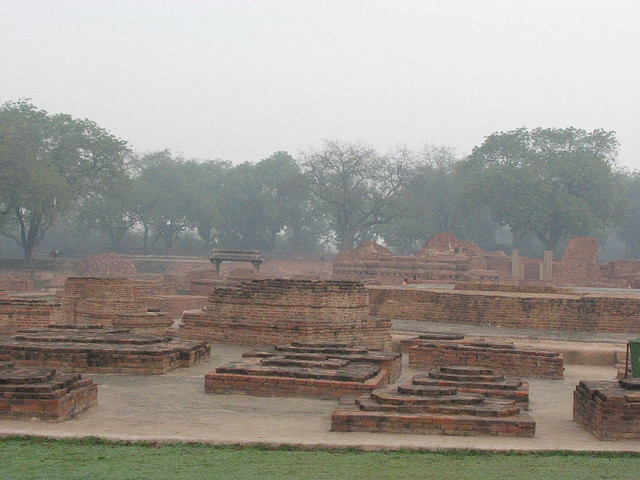
Within the Buddhist tradition, Varanasi occupies an equal place alongside Lumbini and Bodh Gaya and is a stone’s throw away from the deer park at Sarnath. Buddhists from Sri Lanka and Indonesia regularly visit the city which has also led to the national airlines of these countries to designate weekly direct flights to the newly built international airport outside Varanasi. The Chaukhandi stupa, a short ride away from Varanasi, is a dominating structure atop a huge burial mound. Its previous architecture from the Gupta period has also been modified under the rule of the Mughal emperor Humayun and stands testimony to the many transformations of religious life in the last millennium in South Asia.
Piety has many faces in Varanasi and it would be naive to assume that it is all there is. The city’s many realities are tested against this image time and again and travellers in search for the many-sided and complicated facets of cities would find a lot of food for thought in Varanasi. This city’s immigrant foreign population, much of which is composed of Israeli Jews or residents of the C.I.S states and Eastern Europe, work as yoga assistants or as voluntary labourers in different Ashrams, drive rickshaws or participate in sex work. The impious in the holy city of Varanasi are patrons of non-Indian sex workers, wholly aware of the fetishism of ‘white’ women. These and many other paradoxes are the complicated reality of many cities in the world, to which Varanasi is no exception. While it is important to critically see through the many facades of the city and question its many representations without harbouring prejudiced judgement, it is also important to understand how these differences exist together and against each other, producing a fuller travelling experience.
a poster advertising Ustad Bismillah Khan
Varanasi’s famous silk sarees, known world over for their intricate embroidery and weaving, along with its famous silver ornaments and other metal work is an understated attraction. The weaving process of the Benarasi Silk sarees is a long and arduous one which makes each sari a unique one. Add to that the delicious cuisine of Old Varanasi, most popular during the festivals of Budh Purnima, Maha Shivratri and the Ram Leela, and there is a treat at hand for all the senses as well as the mind. To top it all off, a Banarsi paan (sweetmeats wrapped in betel leaf) and a Bhaang Thandaai (flavoured cannabis-laced cold milk shake) after the meal would make it an experience like none other.
Varanasi has produced many stories. Its voice has been heard across miles of land and sea through those who have spoken of its depths or sung of its beauties. If you have been spellbound by the late Ustad Bismillah Khan playing the Raag Maalkauns on his famous shehnai at the Queen Elizabeth Hall in London, then you would love to see the city where it all began. If you haven’t done either, make the trip anyway – you’ll hear the brilliant shehnai renditions at the Kashi Wishwanath Temple every evening. It is where the great Ustad started off as well.  

Tuesday, January 24, 2012

A whole new meaning to "The world is a book..."


The Khuda Baksh Oriental library
If you have the slightest interest in the magnificent contributions and the complex developments in the world of science, philosophy and medicine in the last few hundred years in South Asia and its surrounding regions, you might want to take a look at the trove that is the Khuda Bakhsh Oriental Public Library in Patna. Often just called the Khuda Bakhsh Library, the residents of Patna have prided themselves over its existence for years. The library has seen the city grow and change around it since the close of the nineteenth century even though the library was conceptualised much before that by Maulvi Muhammad Bakhsh. 

Maulvi Muhammad Bakhsh perhaps always knew that he wanted to leave behind a library for posterity. Presumably taken by the advances in printing culture in the lower Gangetic belt and resigned to the gradual decline of the landed gentry in Patna, he struck upon the idea for a collection of great manuscripts that could be viewed and used by all. Before his death in 1876, he left the solemn task to his son, Maulvi Khuda Bakhsh, after preserving a collection of 1400 manuscripts himself. A noted scholar in Arabic with a great love for Persian and Urdu, Khuda Bakhsh invested all efforts into realising the idea of the grand public library.

Khan Bahadur Khuda Baksh
Khuda Bakhsh was perhaps the best person to set up such a library, if one is to go by Jadunath Sarkar’s description of him as the greatest authority on Islamic bibliography at the time. Having been a lawyer at the Nizam’s court, his knowledge of the different legal strains and schools of law in Islamic jurisprudence as well as the great debates in Islamic philosophy at the time, was extensive. All in all, he made sure he expanded on his father’s collection of manuscripts sizeably from the original 1400 manuscripts in 1876 to the 5000 documents by the time of his own death in 1908. 

From Sarkar’s description of the man, one finds an image of a serious scholar committed to preserving the knowledge of his time, influenced strongly by a colonial modernity and its spill-over effects. The huqqa-smoking bibliophile now rests in a grave on the premises of the library, oblivious to the generations who have gained from his efforts. His son, Salahuddin Khuda Bakhsh, who took over the reins of the library after his death, was thankfully a similarly dedicated bibliophile. What many don’t know is that he is most famous in literary circles for inviting a fatwa from a fringe Muslim seminary in Patna because he took on a translation project of Joseph Hell’s book ‘Arab Civilisation’ in 1977 from the Jamia Milia Islamia in New Delhi. The scholar Girija Kumar has argued elsewhere that this effort was just another instance of Salahuddin’s attempts to engage with texts that were critical of orthodoxies in Islam. Criticism and reasoned well-knowing debate was the underlying force behind his intellectual drive and it shows amply in the collection at the Library.

If the rich history of the library’s fountainheads is alluring, then the range of collections that the library holds should surely make you jump. Classics from Urdu, Persian and Arabic along with travelogues and rare copies of controversial publications are strewn across the shelves at the Khuda Baksh Library. Sample this: the Jahangir Nama, the Sirat-i-Firoz Shahi, a huge range of publications on Tibb (medicine), translations and original drafts of many biographies (Tazkira) and books numbering more than two hundred and fifty thousand. Biographies were of extreme importance to both Khuda Bakhsh and his son, as a result of which, one sees the vast number of biographies, both translated as well as the original versions in the library. Similarly, memoirs and travelogues like the Ibrat Namah and the Masir-i-Talibi, providing rich accounts of a different time on the continent, are now freely available for students and lovers of history and literature.

Forceps from the era
The Yunani Tibb system of healing and medicine that underwent thorough changes with the introduction of colonial knowledge on surgery and pharmaceuticals would probably have lost a large part of its own scientific history had it not been for the preservation of documents in the Khuda Bakhsh Library. The efforts here are parallel to those made by the famous Hakim Ajmal Khan in then Shahjahanabad, or Old Delhi as we now know it.

Today, the looming building of the Khuda Bakhsh Library has undergone several changes. Many of its collections have been digitized and available for perusal on its website. Many scholars from Patna and the rest of the country have benefitted hugely from these efforts in the last few years by the National Mission for Manuscripts and the administration of the Library. Works on the Safawis (the Safavid Empire) and the Qajars, preserved in the Library, have now helped write broader connected histories of Islamic scholarship across the breadth of Asia. 

The library, over the years, has managed to gather around itself a milieu of academic and cultural efforts that help in its sustenance. Its assemblage of various historic scientific instruments as well as its collection of vivid Patna Qalam paintings are the result of careful patronage and dedicated endeavours to preserve the traces of a complex past. Such a past defies many of our assumptions about the development of cultures and their continued sustenance. If you like to allow yourself the luxury to sit and delve into a different time and think through it, the Khuda Bakhsh Library is one of those places that affords you the luxury to do so. And if you still haven’t made up your mind, let’s just say that a look at the centuries-old and vastly famed ‘deer skin’ leaf of the Qura’an should be an ample reward for taking the road to Bankipur in Patna.

Tuesday, January 10, 2012

Foreverest


making molehills of mountains
The Everest Base camp was on the bucket list of Morgan Freeman, Jack Nicholson and almost everyone else who was inspired by the movie – and rightly so. It is one of those places where the sting of the cold mountain breeze slowly turns into a pleasure and the mildly salty tea turns into delicacy. And for those with a knack for goosebumps, there is really no need to fret. We took our own little walk in the hills and came back unscathed. We lived to tell the tale, over and over again, to our folks at home and our envious colleagues in office. And here, definitely not for the last time, is one other telling for you.
For our lazy city legs, so used to personal cars and public transport, the trek began at its hardest. When the plane bumped to a landing at Lukla, the excitement in the cabin was noticeable. And the sharp icy wind on the tarmac at Lukla airport greeted us with a hint of what was to follow. After filling ourselves considerably well on some local meat, we began our trek along with a whole bunch of hikers from Lukla only to realise that the muscles needed much more warming up than what we had leisurely allowed them. Breathing heavy and letting the oxygen sink into our muscles, it was the host of warm tea shops that we used to take a well deserved breather from time to time. Stories about Namche Gompa and the almost-fabled tales of adventures on the Everest were soon pouring in as everyone got familiar with each other. Our guide’s favourite story, which really sounded like a good old local joke, was one about an encounter between a European tourist and a yak which left us rolling on the floor.  A good old hearty laugh is just the kind of cheer one needs while trekking uphill if you’re new to hiking or haven’t hiked in a long while. Before leaving, we got a quick brief on the many detours that one can take, off the beaten path, in case one is interested in a tougher and faster hiking challenge. Without the luxury of tea-houses, these paths are for those who have some wealth of experience in their knapsacks to help them along.
We spent the night at Monju imagining what the hills look like when the rhododendrons blossom in the spring months of February to May. Spring and Autumn are the longest seasons here, interspersed with a heavily snowy winter for three months. Early December is just when the possibilities of heavy snow loom on the horizon and since our love for mountains draped in white was what got us going in the first place, indulging in wishful thinking about hues of crimson and ochre was simply just a good way to lull ourselves to sleep. There’s a lot to observe here for anyone who is excited by the marvels and the anomalies in the geology of the wind-swept Himalayas. Khumbu is all about walking and that gives anyone ample time to stop and take a closer look at things along the way.
Namche Bazaar
Our legs were doing much better the next day. The muscles were warmed up and the slight sores from the hiking boots were nicely covered up with medical tape to pre-empt any rashes. The morning hike to Namche Bazar seemed much more comfortable even though the gradient was far steeper uphill. Namche Bazaar is the glue that seems to hold the whole milieu of Khumbu together. We made it to the Bazaar by three in the afternoon on a Saturday, which was just in time to enjoy the weekly market. Before stocking up with supplies for the road ahead, we got some well needed local currency. Medical supplies and other amenities are sufficiently available and the food is a healthy mix of western and local food. Himalayan cuisine and a pizza shop do good business at the same time in Namche Bazaar and with so much as a “what the hell!”, we decided to try our hands at both.
We gave ourselves a couple of days to acclimatize ourselves to the altitude at Namche Bazaar. Altitude sickness is one of the most common problems and acclimatization is absolutely necessary. What helped us most was a walk to the famed Namche Gompa monastery, from where we walked further down along what is an ancient route to Tibet through Thame. This hike was about a day long but helped us ease into the rigour of the altitude. With just one short stop at Phurte, we hiked straight to Thame Gompa. The absolutely gorgeous sight of the Sunder Peak at Thame, accompanied by the various local myths about the mountain Khumbi Yul Lha [5765m] that we heard in great detail from a local doctor friend from the Khunde Hillary Hospital, made this short detour worth its while.
The Sagarmatha National Park
Our many conversations were quite insightful to say the least. The most heated topic of discussion was the proposed rail link between the city of Beijing and Lhasa that would be further extended to a point that is as close as possible to the Everest Base Camp, from the North-East. While many feared that the joys of walking across the Sagarmatha National Park, where other modes of travel are virtually absent, would be ruined with the rail link, others seemed to hold concerns of the local economy and the environment’s ability to take more human traffic. We returned to Namche Bazaar considerably better informed about the deeper and subtler fault lines in this part of the Himalayas.
The next day’s hike was easier on the muscles, given the two days in Namche Bazaar. Armed with fresh supplies, we headed for Tengboche. The water-driven prayer wheels at Phungi Thanga on the way were an absolute delight and the people were more friendly than usual as they headed us off towards the steep climb to Tengboche, warning us most profusely to go slow given the thin air at the altitude. We spent the night at the village before taking on the daunting climb to Pheriche. This particular climb allows rather little time to see or explore anything if one is hiking slowly. The stinging air at Pheriche pass is quite a mouthful and it is advisable to prepare oneself for the altitude as much as possible. We took another whole day at Pheriche to acclimatize ourselves and some light breathing exercises are most useful. We took a short trip to the Tokyo Medical University Clinic and met some very dedicated professionals, leaving us both reassured and inspired.
From Pheriche, we began the last leg of our climb till Lobuche. After a generally uneventful hike and some delicious hot soup, we bottled our excitement long enough to wake up at the break of dawn the next day. We were ready in seconds for the hike to Gorak Shep which, we solemnly heard, was not as easy as it sounds. Regular conversations with fellow trekkers made the journey much more memorable for us. Recharged camera batteries were put to great use on the way to capture the white and blue hues of the Khumbu Glacier. The Lobuche Pass at 5110m was stunning in the quiet gleam of the afternoon sun and we waited with bated breath for what was to come.
The lodge at Gorak Shep
Dusk at Gorak Shep was possibly the crowning glory for all the sweat and toil till then. The twilight-orange wall of ice at the peak of Mt. Everest, or Chomolungma, seemed like a piece of mysterious art, about to dissolve into the night, only to reappear for those who walked all the way till here to admire its beauty. As the snow-clad peak changed colours with the setting sun, we cracked a joke or two about a joyful Edmund Hillary murmuring “Tomorrow morning it is, eh?” to an excited Tenzing Norgay before tucking in, one such night many years ago. We shared the excitement, better late than never.   


Monday, January 9, 2012

Winter fashion in India


The intricacies of a phiran
January is still the time of comfort foods and cosy blankets. Though winters in the plains or near the coast of India are equivalent to spring or summer in some countries, the mountains are the real deal. In some of the lesser known places in the Himalayas or the foothills, temperatures drop to -20 degrees centigrade and winterwear becomes and essential part of daily fashion. India being innovative, we had just decided to wrap cool light blankets around us and call them shawls. Moreover, India being diverse, the shawls in different parts of the country are also different.

The phiran is an example of an elaborate and unique form of craftsmanship. Made from wool and often complemented by Pashmina or Shahtush shawls in the Kashmir valley as well as Jammu, the Phiran is worn by both men and women. Different specificities in designs and embroidery methods often distinguish the craftsmanship of one amongst the others. The production of phirans has increased in recent times and older weavers have considerably expanded their reach of customers. Export trade has managed to make this loose but extremely warm piece of winter wear quite popular in many parts of the world. 

Flair at the hornbill festival
The Naga Shawl is one singular piece of woollen wear that manages to stand out while keeping you as warm as possible. Thickly knitted with wool and often dyed in red, black or a mix of both, the naga shawl is convenient and hence, extremely popular. It is found in both niche markets and popular ones depending on where you are but each single Naga shawl delivers on its promise against the cold breeze that threatens to find its way through the pores of your sweaters.

The woollen Nehru Jacket, made most popular by the first Prime Minister of India, Jawaharlal Nehru, is an elegant and useful coat that can easily blend into the aesthetic of any kurta-lover. The Nehru jacket highlights the breadth of the shoulders and provides just enough warmth for the mild winter days. Complemented with a shawl, the Nehru coat can significantly enhance the appearance of matching collar shirts as well as longer kurtas. 

where the wool comes from
The Pashmina Shawl perhaps needs the shortest introduction. It is widely known for being one of the warmest and the most exquisite garments in the world. Made from goat wool across the lower Himalayas, the shawl has only gained in popularity over centuries of trading relations across the Indian Ocean as well as the Hindu Kush. It is preferred by people of all ages and is treasured as a possession. Fashion designers often experiment with Pashmina shawls in order to bring out the contrast of the their bright colours against the sober grayness of winter.


Thursday, December 15, 2011

Tunes from the East - Baul Music in India


A baul performance in progress
The eastern region of Bengal has long had a history of syncretic music that finds its metaphors in a direct and not ritualistic connection to god. Such spiritual meanings have been articulated by singer-performers across the region for several centuries now. Both the mystic faquirs and the itinerant Bauls are examples of this as their music and allegorical stories transcend the limitations of orthodox and ritualized religion. 
 
Disorder, restlessness and madness are a few of the meanings associated with the word Baul. Such meanings are both prescribed by structures of doctrinal Vaishnavite Hindu religion as well as self-defined by the Baul. It is through an attack against the hierarchical and dominating Vaishnavism [Hindu order with ritual worship of the god Vishnu] that such music and spirituality articulate themselves and hence, often, are seen as deviant and ‘mad’. In many ways, the Bauls have eluded the prescribed order through the content of their music and often their lifestyles. 
 
An artist's rendition of Lalon Phokir
Today, Baul music is quite popular as many artists are experimenting with its forms and content. It is now a genre that permeates the living rooms of many folk enthusiasts across the world. I might not be wrong in saying that the famous nineteenth century Baul, Lalon Phokir who was known in the narrow roads and along the banks of rivers across hundreds of villages in rural Bengal would find it hard to identify with Baul singers of the present day. Today, they regularly record in studios and feature on television and radios. But for all these changes, one must credit the Baul music for maintaining its inherent message and its perceived worldview.

Baul music is distinct in its lyrical content which is avowedly against dominant norms. Largely addressed to a divine presence, Baul songs describe the disjunction between man and spirituality. Declarations of love are a common feature of Baul lyrics, thus persistently disregarding caste hierarchies and religious differences. Influenced by the Bhakti and Sufi movements, Baul music is a unique expression of a quest for spiritual fulfillment through love. 
 
Rabindranath Tagore (right) was one of the first people to translate Baul lyrics to English
Interestingly, it was not until the nineteenth century that the lyrics of Baul songs were actually written down as opposed to the practice of orally transmitting songs. In the early decades of the twentieth century, Nobel laureate Rabindranath Tagore translated many Baul songs into English and described Bauls in his speeches across Europe as an essential component of rustic Bengal uncorrupted by the influences of colonial modernity.
Just like the vagueness surrounding their origin, the lack of the recorded presence of their music is often regarded as a political choice on the part of Bauls. A fascinating culmination of knowledge passed orally through centuries and sharp political articulations of identities in nineteenth century colonial Bengal, Baul music is a subversive, rustic and peripatetic existence.
A Baul can be spotted in his/her saffron robe with long hair tied in a bun on the top of the head and carrying Gopiyantro or Ektara which is an instrument with one string, sometimes in conjunction with a dugi (kettle drum) tied around their waste. Ghungur, doatara and kortal are other commonly used instruments. Baul music is found in present day Bangladesh as well as the Indian state of West Bengal, displaying a characteristic disregard for man-made boundaries. 
 
There are a few organized festivals that celebrate the poetry and music of Baul, which are held annually in Bengal. Poush Mela, an annual three day festival held in Shantiniketan in the Birbhum district of West Bengal is an event that attracts the largest number of Bauls. It is held at the start of the month of Poush according to Bengali calendar (third week of December) and marks the establishment of the Brahmo religion. Another large annual gathering of Bauls occurs in Joydev Kenduli which is regarded as the birth place of poet Jayadeva and coincides with Makar Sankranti which marks the beginning of winter harvest and is considered auspicious. The last one is the Ghoshpara festival in the 24 Parganas district in March-April which coincides with the birth anniversary of Lord Krishna. 
 
A performance at the Baul Fakir Utsav
Over time, more urban audiences have flocked to annual shows held in Kolkata city such as the Baul Fakir Utsav where Bauls from different districts of Bengal and Bangladesh come to perform. It usually goes on for 48 hours and offers those, who do not seek to travel to rural events, an experience of folk and mystical music right in the heart of urban landscape. The more famous Baul singers of today include Purno Chandra Das , Jotin Das Baul , Sanatan Das Thakur Baul and Parvathi Baul but the list is gradually and progressively increasing.