Showing posts with label India. Show all posts

Tuesday, August 21, 2012

We Took a Break.

So, remember how we told you how much we love travelling at Indebo? Well, this time we took all that love one notch up – we decided to put together a trip for all our staff at the office. Following a lot of arguments, we figured the one place where such a large group could peacefully relax and let their hair down could only be Kerala. It’s the Malabar, after all – blue water and blue skies, that is, if you manage to see past the deep green foliage above your head, and a significantly relaxing cultural atmosphere. By the time we set off from Delhi, everyone was basically looking forward to some delicious food, some simple travelling and a lot of bonding.

At first glance, the first day of the itinerary looked simple – getting  off the flight at ten, with the next  four hours earmarked as “local sightseeing around Cochin”, following which would be a lavish lunch. Only, that wasn’t entirely accurate – it came with a twist! Once everyone was out of the airport, they were handed an envelope each. A solitary card inside carried the name of a spice – the Malabar was also spice country, after all!

Historically speaking, it is practical knowledge for Malabari chefs – want some spices, get to Alleppey! Anyway, the ones who got the same ‘spice card’ then made a team – so we had six in all. Garam Masala, Red Chillies, Bay leaves, Yellow Turmeric, Green Cardamom and Black Pepper – our six teams then got into their coaches which dropped them off at different points around the city with one line of a clue each.

Indebo Staff at Cochin Airport
Yes, this was the madness behind the innocent itinerary! Inspired by the popular show ‘The Amazing Race’, our organising team had decided to put together a hunt of our own. Within the hour, there were six groups of Indebo staffers chasing down clues across Cochin – clues included everything and anything historical. From one of the oldest churches in the countries (Santa Cruz), sari weavers in Ernakulam district, the famous Cochin Synagogue and one of the oldest gold craft showrooms – clues were scattered everywhere that required the teams to fish deep and think hard. While some searched for the guide who held the next clue at Santa Cruz, others decided to talk to the salesmen and craftsmen in order to scoop out the other clues.

By the time all the clues were discovered, the last of which was the same for everyone – the link to the place where lunch was scheduled – it was the Green Cardamom team led by Ibotombi Singh that had emerged the clear winner. As the rest of the teams trooped in slowly, signs of the gruelling challenge showing on their faces, a large container of Biryani was brought in to be plated. Both relief and satisfaction lined everyone’s face. And based on the responses we got to a review questionnaire after the trip, this meal was rated as the best – not just because it was simply outstanding but because the treasure hunt had made sure everyone was hungry enough to love each and every bit of the lunch.

Indebo Staff at Kathakali performance
That evening, at Casino hotel, all the ladies were handed saris and the men were given mundus – both traditional pieces of Malayali clothing which was also our own dress code for the Kathakali performance scheduled at Fort Kochin at night. The expected unease with such traditional clothing from people mostly used to western formal wear was nowhere to be seen – everyone seemed to be in the mood for challenges and they pulled the garments off in style. Their grace took our hosts completely by surprise – at the Kathakali auditorium, the manager actually asked how many of us were from Kerala itself. He couldn’t believe the answer!

Everyone got a short lesson on make-up art before a Kathakali performance, one of the most crucial ingredients that requires an exceptionally firm and artistic hand. The performance itself was followed by dinner at the Brunton Boatyard – a fabulous place right next to the sea. Given all this activity, we were sincerely hoping the excitement didn’t wear off by the next day – and we were pleasantly surprised.

Everyone seemed ready for another go by breakfast next morning – and this time our destination was Vaikom and Kumarakom. We stopped to take a walk through the large yard and lawns at the famous Sree Mahadeva temple on the way before splitting up into two teams – this time, for sharing time between the activities planned for the day. So while one group went off to learn about coir making and coconut processing, the other got canoe rides through the backwaters, taking notes on fishing and toddy-tapping. A couple of hours later, the groups switched amidst excited conversations about tasting local toddy and shopping for coir handicrafts.

Lunch was scheduled at the village residence of one of Indebo’s oldest associates in Kerala – the meal, served on banana leaves, included all kinds of Malayali delicacies, topped off with generous portions of banana fritters. Needless to say, this meal came a close second on the best meal question in our official review. We spent that night at the beautiful Coconut Lagoon resort, after watching the sunset on the backwaters from the roof of a houseboat on Vembanad Lake. This short cruise got everyone in the mood for more time on the lagoons the following day.

Vembanad Lake is part of a cosy waterway leading to Muhama – so we set off next morning on a luxurious houseboat along the waterway. The smell of spices floated off from the villages lining the waterway and we had cheerful exchanges with school kids on holiday who were lazing by the banks – in India, curious travellers always give kids a reason to share a joke or two, followed by splits of uncontrollable giggles!

Serene Lands of Alleppey
By early afternoon, we had finished off a sumptuous meal on the houseboat and landed near Alleppey. Since the evening was free, many took off to shop immediately – from banana chips, sarees, trinkets and nuts to the conspicuously huge umbrellas and school bags, everyone had an interesting selection of purchases. The bout of shopaholism soon gave way to beach chairs at Marari beach resort – a luxury that no one had in the last two days.

Before dinner, we had scheduled another exceptional performance – Kunchan Nambiyar’s legendary compositions as an Ottam Thullal. The other two types of the Thullal are the Seethankan Thullal and Parayan Thullal. While most didn’t understand the Malayalam poetry, the element of satire and ridicule was lost on none – Nambiyar’s excellence as a popular poet revealed itself through the performance as the fourth wall was made to seem like a nonexistent category – the dancer made different parts of the whole auditorium a prop to his art. From the intermittent swearing and the lyrical exposition, there was everything that Ottam Thullal is known for. Such was the energy in the performance that even the audience’s laughter became an accessory for the dancer on various occasions. Memorable wouldn’t even begin to describe the evening – no one could stop talking about it even after dinner.

Next morning was our last day in Kerala. So we decided to pick up bicycles and ride through the famous fishing villages near Mararikulam. Those who weren’t bicycle enthusiasts decided to either laze by the swimming pool or take a wonderful Heritage Walk. This heritage walk was organised by the Ladies’ Wing of the local chapter of the Lion’s Club. Under the banner of ‘Preserve Alleppey’, Mrs. Rani John works with other members to archive and preserve the oldest buildings in the town and promote cleaner streets and neighbourhoods. The Walk included both small and big aspects of the town – from coir-making units and churches to heritage buildings made from stone imported from Surat in Gujarat during the heyday of Gujarati mercantilism in the region.

By the evening, we had even managed to find people enthusiastic for a yoga session with a well known yoga practitioner – the whole day seemed to be about rejuvenation. But our excitement was yet to come undone – there were still some plans left to be unpacked. Mr. Verghese, the Administrative head at our office in Delhi was given a birthday party that took him completely by surprise! While he was summoned by our Managing Director under the pretext of official work, our office team put together a lavish party, complete with party hats and masks – leaving Mr. Verghese to find himself in the middle of a surprise carnival in his honour. The party was also an occasion to give away awards to the team that won our crazy Amazing Race which was then followed up with yet another surprise! Most people felt that it was unfair that Rajesh had to be away on this staff trip on the day of his wedding anniversary – dedicated that he is to his work; we figured it would be momentous if we celebrated his anniversary with him! Rajesh couldn’t believe his eyes when he saw what everyone had got him – a model replica of a famous houseboat with white sails from the workshops along the backwaters in Alleppey.

The drive to the airport at Cochin next morning was a sleepy one. High and dry after the previous night, there were a lot of good dreams to have in the days to come. Such is the nature of the travel bug – it leaves for a while, only to return again with something more novel than the last time.

Tuesday, March 20, 2012

great escapes and tiny islands


sometimes you dont need photoshop
Imagine a dot on a map. Imagine a handful surrounding it. Then fill the rest with sparkling blue and keep some green for when you get closer. That, in short, is the stunning aerial view of the famous Lakshadweep Islands, off the coast of Kerala, nestled in the expansive Indian Ocean. It is a universe on its own with coconut and palm trees as the dominant inhabitants, making humans look like small fry. This least populated territory within the Indian Union contributes the highest share in production of coconut and coconut-based products. This and several other reasons make the Lakshadweep islands our focus of the month. 

Accessible by both water and air, these set of islands have become favourable travelling destinations in the last few years. While regular boats and steamers operate from the port at Kochi, the island of Agatti has an air strip which facilitates air travel from the Kochi airport. Recently opened resorts and an established infrastructure for water sports and marine study make any itinerary extremely exciting. 

scuba diving in Lakshadweep
In terms of depth, both literal and more abstract, any discerning traveller would have a feast. While snorkelling and diving can mark half the itinerary, there is a host of learning in store in the enthused fishing villages that could take up most of your time. But before much of that, there is a sense of pristine physical beauty that needs imbibing. Lakshadweep is a set of atolls, a rare geographic occurrence wherein a lagoon of sea water is either partially or completely surrounded by a coral reef. Atolls are only seen in tropical and sub-tropical climate and offer an opportunity to study diverse forms of marine flora and fauna. Once the general singularity of these island formations is clear, a lot of natural phenomenon can be understood such as fishing seasons, fishing techniques, land mass formation and biospheric interactions. 

The islands have been historically quite eventful, from the Pallava and Chera kingdoms when it was an essential outpost for coconut trade and naval control to the modern day Indian state, where it holds similar relevance. Cultural similarities to Kerala are present in terms of language and local customs but those have significantly transformed in relation to the surrounding environment. Diversity within the islands is also an interesting facet for curious travellers – the variety of dances like the ‘Lava’ and the ‘Kolkali’ and the fascinating spatial organisation of villages according to organic norms of sustainability. Access to the islands is regulated via permits by the Indian State at present in order to stay in line with the concerns of the environment.

the kavaratti islands
The set of coral islands is mostly being promoted by the local government setup under the Society for the Promotion of Nature Tourism and Sports. The islands of Kavaratti, Kadmat and Minicoy have been equipped with training facilities and instructors for deep-sea diving, snorkelling, fishing, kayaking, canoeing, wind-surfing and sailing in glass-bottomed boats. Additionally, the lagoons themselves offer ample scope for idyllic leisure, ranging from a lazy swim to kayak training. The fauna in the region is mostly fish – the famed barracuda, various kinds of tuna, eels, turtles home amidst an exquisite array of coral habitat. 

The sensitivity of the environment requires strict supervision of one’s personal habits – littering is strictly prohibited as is defacing or picking up/breaking off pieces of the coral as souvenir. A visit to the islands helps in empathising with the delicate concerns of sustainability and leaves one much wiser on many counts. The realisation helps – mostly when one takes a boat to the Dolphin Dive Center in Kavaratti, where the unique Gray Reef sharks and the Spotted Eagle Rays, which are some of the most beautiful and singular inhabitants in this part of the ocean. 

Distinctively more enthralling is the experience with diving or snorkeling in the shallow seas – soft coral reefs of the brightest colours, red and yellow, and caves with a large turtle population can potentially take your breath away! Under water, that may be risky but the experience of such a marine ecosystem is literally worth it.

Friday, February 3, 2012

all you needed to know about selling your cow


sailing down the river
The Gandak is a majestic river, draining in its wake more than seven thousand square kilometres of land as it flows down to meet the Ganga. The meeting is of course, legendary. Not just because it is an extremely beautiful confluence of rivers but also because it is the site of Asia’s biggest congregation for trade in livestock. Since two smaller tributaries also join the Ganga at this point in its course, the Sonepur fair is quite strategic in its location vis-a-vis trade, both on land routes as well as waterways.
The fair sees much more than the regular rural livestock trade in cattle, horses, camels and sheep. The range of animals includes rare bred dogs, elephants, cats, monkeys and rabbits. And if Alsatians and Terriers weren’t enough for those fond of domestic animals, then there is a large variety of birds, some even as rare as the Snow Partridge that is usually found in much colder climate and the Grey-headed Parrot from the hills near Darjeeling, which are lined up for sale. The ways in which this annual fair links itself to a number of interconnected networks of trade in the local region as well as the other parts of the world is hard to imagine. A simple tabulation of different kinds of animals and goods that are bought and sold at Sonepur, both legally and illegally is a massive and daunting task. In terms of illegal trade, snakes, bears and intoxicants of a large variety are easy answers but on digging deeper, there are a lot of stories left to tell about Sonepur’s thriving trade environment.
 Sonepur, by itself, is a largely unassuming city. One could get by without much effort while being quite taken by some of its singularities. The old Gandak Railway Bridge is one such example – more than two thousand feet long and completed in 1887 during some of the river’s furious years. With the regular floods in Bihar during the last years of the nineteenth century and the successive floods in the last few decades, Sonepur’s culture and social life has survived just like its famous landmark. The first railway platform at the Sonepur railway station is another such marker to anyone stepping foot in the city. Far longer than the more famous bridge, this platform is one of the longest in the world, stretching to more than two thousand four hundred feet. But these dimensions slowly seem to cease as the fair makes claim to the pulse of Sonepur’s life.
Celebrations during Kartik Purnima
The Kartik Purnima is an auspicious day for Hindus and Sonepur’s charm is the throbbing life on this full moon night, filled with devotees lining up to take a dip at the confluence of two mighty rivers. Many stay on for the entire fortnight of the festival while others leave within the next few days although trade goes on well into a month from the date of the Kartik Purnima. The story goes that the Mauryan Empire bought its warhorses and elephants from Sonepur after breeders had travelled for miles to arrive at the banks of this confluence. Most local tales around the fair’s origins describe the confluence as one of five rivers, as famous as the kind of animals that frequented the annual fair – Persian horses, Burmese elephants and rare birds and animals along with elaborate displays of pottery and textiles from the span between Central Asia and the Gangetic belt.
The first day also marks the worship at the Harihar Nath temple, which is the epicentre of activity on that day. Offerings and ablutions are part of the rituals and needless to say, there is a fair bit of waste that accumulates around the fair. While public toilets are scant, relief mostly presents itself in the proximity between the mango groves where the fair is held and the tourist accommodation. The routes are lined with regular forms of entertainment – fortune tellers, soothsayers and those trained in various human feats like trapeze art or the more spectacular acts like walking on burning coal.
An all-male crowd watches a dance show in progress
In many senses, the fair is also a reality check. One would be quite taken aback by the vigour that nightly dance shows are treated with. It has been regular practice, for the last few years, to hold nightly dance shows where women take the stage to dance to the most popular dance tracks of the year as well as the older well-known songs. It should suffice to say that this is a comment on one facet of the gendered economy in this part of the world. While many commentators have called these shows ‘vulgar’, leading to the State Government’s ban on these shows in 2011, it was an open secret that these shows continued in local venues. That there is marketability to such practices gives a foreign visitor, even from a city a hundred miles away, that there is a strong clash between the national discourse on women’s empowerment and the prevailing economic and social constraints for women in most parts of India.
Additionally, while trade in endangered birds and animals is otherwise illegal, it is a flourishing activity in the backdrop of this popular fair. The district administration takes many measures to clean up the negative publicity that the Sonepur fair gets every year but little in terms of results is discernible. Sonepur, by and large is distracting because there is so much to take in at any point of time. While there are so many concerns with how the fair progresses, there is also the visibility of different forms of livelihood on such a massive scale. From potters to the makers of different weapons and artefacts, one can easily find some interesting story to hear – of some new kind of trade or craft which puts into perspective many other things that one sees in life outside Sonepur in Bihar.
Birds of a feather...
Bihar is a state in India that is hardly well-known for things considered great by the national media. Many of its stories and its problems are unheard of and the few times that one hears of them are hardly remembered amidst the blaze of information. That it can provide a lot of fodder for thought to any curious traveller in South Asia is needless to say. Sonepur is perhaps one of those places to start with, in Bihar. The range of art, especially the Madhubani art from the region, the architectural and historic attractions of the region’s Buddhist and Jain history, and the excellent street food is enough to make a visit to Sonepur memorable. The must-eat is of course the ‘bhang ka pakoda’, a fried snack laced with cannabis resin, that is otherwise a delicacy on the famous festival of Holi around the country and in our case, a regular with visitors to Asia’s biggest cattle fair.

Thursday, February 2, 2012

of circles and lives


sunrise on the Ganges
Varanasi is a place that gleams. It gleams at night, when the lamps on the ghats cast their soft impressions upon the rolling waves of the Ganga. It gleams at noon as the sharp rays of the sun reflect onto the eyes of a careless onlooker. And it gleams at dawn and twilight with colours that would make a mixed palette left to fade in an artist’s workshop. The splash of lights and colours in its busy markets and in the rows of shops that line the ghats reflect upon the people who flock to this bustling town every day. The rail link between Mughal Sarai and Varanasi, opened in 1862 and the rail-cum-road bridge across the Ganga which was opened in 1887, made sure that this famous ancient town of worship was more accessible for visitors from across the region.
Today, Varanasi is nothing like it was when its first railway station made mass transit a realisable dream for many. Varanasi today, like many other famous small towns and cities in South Asia, is facing a continuous friction between the ‘new’ and the ‘old’.  Someone who has lived and grown up in the pre-colonial localities of Delhi and Lucknow may well be able to sympathise with Varanasi on several different grounds. As the cramped and narrow gullies of Old Varanasi, home to the silk workshops of many famous Muslim weavers of the Julaha caste, contend with the issues of livelihood, a few miles away lie extremely posh residential areas which are seemingly oblivious to the hundred and forty thousand strong slum population in the city.
Dashashwamedh Ghat in Varanasi
With a deep location within the historical development of the various distinctive Hindu, Muslim, Buddhist and Jain traditions in South Asia, Varanasi is a microcosm in its own right. The Dashashwamedh Ghat, supposedly named after Brahma’s sacrifice of ten sacred horses, is a household name with anyone who is fond of the city. A stone’s throw away from the gilded facade of the massive Kashi Wishwanath Temple, this ghat is witness to a lengthy ritual worship of the Sun god and the god Shiva every evening which attracts devotees and tourists in hordes. Spectacular displays with fire light up the face of the river as the drone of the chanting makes everything else inaudible, taking everyone in its wake as the ceremony progresses. The acclaimed film maker Satyajit Ray made these riverside ritual gatherings part of his subject in the famous film based on his equally famous detective novel, Joi Baba Felunath, which brought out the sinister as well as the beautiful around these ritual practices in Varanasi.
The other equally famous ghat in Varanasi is the Manikarnika Ghat, a site for ritual cremations on funeral pyres. Mostly done with sandalwood, hundreds of dead bodies are lined up at the ghat for cremation. Broadly, the Dom caste, which is traditionally an untouchable caste, is responsible for dealing with all that is deathly in dominant Hindu society. It is in Varanasi that this form of oppressive and stigmatised division of labour has perhaps also given Doms a visible prominence, as the ritual order considers working with dead bodies a polluting act and hence needs the Doms. This has also led to the famous titular role of the Dom Raja in Varanasi while at the same it has also meant that the caste-marked livelihoods of many depend on sifting through the ashes of dead bodies in search for precious ornaments like rings or even gold teeth as well as discreetly re-selling ornamental funeral shrouds which are otherwise meant to be specific to each funeral. Beyond Manikarnika ghat lies the Harishchandra Ghat, which is a similar site but is used by families which can’t afford expensive sandalwood. Together, these two ghats hold the term, the ‘burning ghats’, as the funeral pyres are forever burning, a sombre sight on the breezy dark nights along the Ganga in Varanasi. 
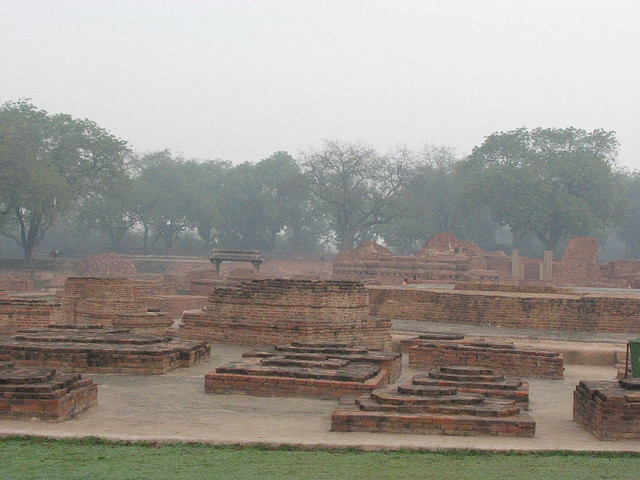
the ruins at Sarnath
Within the Buddhist tradition, Varanasi occupies an equal place alongside Lumbini and Bodh Gaya and is a stone’s throw away from the deer park at Sarnath. Buddhists from Sri Lanka and Indonesia regularly visit the city which has also led to the national airlines of these countries to designate weekly direct flights to the newly built international airport outside Varanasi. The Chaukhandi stupa, a short ride away from Varanasi, is a dominating structure atop a huge burial mound. Its previous architecture from the Gupta period has also been modified under the rule of the Mughal emperor Humayun and stands testimony to the many transformations of religious life in the last millennium in South Asia.
Piety has many faces in Varanasi and it would be naive to assume that it is all there is. The city’s many realities are tested against this image time and again and travellers in search for the many-sided and complicated facets of cities would find a lot of food for thought in Varanasi. This city’s immigrant foreign population, much of which is composed of Israeli Jews or residents of the C.I.S states and Eastern Europe, work as yoga assistants or as voluntary labourers in different Ashrams, drive rickshaws or participate in sex work. The impious in the holy city of Varanasi are patrons of non-Indian sex workers, wholly aware of the fetishism of ‘white’ women. These and many other paradoxes are the complicated reality of many cities in the world, to which Varanasi is no exception. While it is important to critically see through the many facades of the city and question its many representations without harbouring prejudiced judgement, it is also important to understand how these differences exist together and against each other, producing a fuller travelling experience.
a poster advertising Ustad Bismillah Khan
Varanasi’s famous silk sarees, known world over for their intricate embroidery and weaving, along with its famous silver ornaments and other metal work is an understated attraction. The weaving process of the Benarasi Silk sarees is a long and arduous one which makes each sari a unique one. Add to that the delicious cuisine of Old Varanasi, most popular during the festivals of Budh Purnima, Maha Shivratri and the Ram Leela, and there is a treat at hand for all the senses as well as the mind. To top it all off, a Banarsi paan (sweetmeats wrapped in betel leaf) and a Bhaang Thandaai (flavoured cannabis-laced cold milk shake) after the meal would make it an experience like none other.
Varanasi has produced many stories. Its voice has been heard across miles of land and sea through those who have spoken of its depths or sung of its beauties. If you have been spellbound by the late Ustad Bismillah Khan playing the Raag Maalkauns on his famous shehnai at the Queen Elizabeth Hall in London, then you would love to see the city where it all began. If you haven’t done either, make the trip anyway – you’ll hear the brilliant shehnai renditions at the Kashi Wishwanath Temple every evening. It is where the great Ustad started off as well.  

Tuesday, January 24, 2012

A whole new meaning to "The world is a book..."


The Khuda Baksh Oriental library
If you have the slightest interest in the magnificent contributions and the complex developments in the world of science, philosophy and medicine in the last few hundred years in South Asia and its surrounding regions, you might want to take a look at the trove that is the Khuda Bakhsh Oriental Public Library in Patna. Often just called the Khuda Bakhsh Library, the residents of Patna have prided themselves over its existence for years. The library has seen the city grow and change around it since the close of the nineteenth century even though the library was conceptualised much before that by Maulvi Muhammad Bakhsh. 

Maulvi Muhammad Bakhsh perhaps always knew that he wanted to leave behind a library for posterity. Presumably taken by the advances in printing culture in the lower Gangetic belt and resigned to the gradual decline of the landed gentry in Patna, he struck upon the idea for a collection of great manuscripts that could be viewed and used by all. Before his death in 1876, he left the solemn task to his son, Maulvi Khuda Bakhsh, after preserving a collection of 1400 manuscripts himself. A noted scholar in Arabic with a great love for Persian and Urdu, Khuda Bakhsh invested all efforts into realising the idea of the grand public library.

Khan Bahadur Khuda Baksh
Khuda Bakhsh was perhaps the best person to set up such a library, if one is to go by Jadunath Sarkar’s description of him as the greatest authority on Islamic bibliography at the time. Having been a lawyer at the Nizam’s court, his knowledge of the different legal strains and schools of law in Islamic jurisprudence as well as the great debates in Islamic philosophy at the time, was extensive. All in all, he made sure he expanded on his father’s collection of manuscripts sizeably from the original 1400 manuscripts in 1876 to the 5000 documents by the time of his own death in 1908. 

From Sarkar’s description of the man, one finds an image of a serious scholar committed to preserving the knowledge of his time, influenced strongly by a colonial modernity and its spill-over effects. The huqqa-smoking bibliophile now rests in a grave on the premises of the library, oblivious to the generations who have gained from his efforts. His son, Salahuddin Khuda Bakhsh, who took over the reins of the library after his death, was thankfully a similarly dedicated bibliophile. What many don’t know is that he is most famous in literary circles for inviting a fatwa from a fringe Muslim seminary in Patna because he took on a translation project of Joseph Hell’s book ‘Arab Civilisation’ in 1977 from the Jamia Milia Islamia in New Delhi. The scholar Girija Kumar has argued elsewhere that this effort was just another instance of Salahuddin’s attempts to engage with texts that were critical of orthodoxies in Islam. Criticism and reasoned well-knowing debate was the underlying force behind his intellectual drive and it shows amply in the collection at the Library.

If the rich history of the library’s fountainheads is alluring, then the range of collections that the library holds should surely make you jump. Classics from Urdu, Persian and Arabic along with travelogues and rare copies of controversial publications are strewn across the shelves at the Khuda Baksh Library. Sample this: the Jahangir Nama, the Sirat-i-Firoz Shahi, a huge range of publications on Tibb (medicine), translations and original drafts of many biographies (Tazkira) and books numbering more than two hundred and fifty thousand. Biographies were of extreme importance to both Khuda Bakhsh and his son, as a result of which, one sees the vast number of biographies, both translated as well as the original versions in the library. Similarly, memoirs and travelogues like the Ibrat Namah and the Masir-i-Talibi, providing rich accounts of a different time on the continent, are now freely available for students and lovers of history and literature.

Forceps from the era
The Yunani Tibb system of healing and medicine that underwent thorough changes with the introduction of colonial knowledge on surgery and pharmaceuticals would probably have lost a large part of its own scientific history had it not been for the preservation of documents in the Khuda Bakhsh Library. The efforts here are parallel to those made by the famous Hakim Ajmal Khan in then Shahjahanabad, or Old Delhi as we now know it.

Today, the looming building of the Khuda Bakhsh Library has undergone several changes. Many of its collections have been digitized and available for perusal on its website. Many scholars from Patna and the rest of the country have benefitted hugely from these efforts in the last few years by the National Mission for Manuscripts and the administration of the Library. Works on the Safawis (the Safavid Empire) and the Qajars, preserved in the Library, have now helped write broader connected histories of Islamic scholarship across the breadth of Asia. 

The library, over the years, has managed to gather around itself a milieu of academic and cultural efforts that help in its sustenance. Its assemblage of various historic scientific instruments as well as its collection of vivid Patna Qalam paintings are the result of careful patronage and dedicated endeavours to preserve the traces of a complex past. Such a past defies many of our assumptions about the development of cultures and their continued sustenance. If you like to allow yourself the luxury to sit and delve into a different time and think through it, the Khuda Bakhsh Library is one of those places that affords you the luxury to do so. And if you still haven’t made up your mind, let’s just say that a look at the centuries-old and vastly famed ‘deer skin’ leaf of the Qura’an should be an ample reward for taking the road to Bankipur in Patna.

Monday, January 9, 2012

Winter fashion in India


The intricacies of a phiran
January is still the time of comfort foods and cosy blankets. Though winters in the plains or near the coast of India are equivalent to spring or summer in some countries, the mountains are the real deal. In some of the lesser known places in the Himalayas or the foothills, temperatures drop to -20 degrees centigrade and winterwear becomes and essential part of daily fashion. India being innovative, we had just decided to wrap cool light blankets around us and call them shawls. Moreover, India being diverse, the shawls in different parts of the country are also different.

The phiran is an example of an elaborate and unique form of craftsmanship. Made from wool and often complemented by Pashmina or Shahtush shawls in the Kashmir valley as well as Jammu, the Phiran is worn by both men and women. Different specificities in designs and embroidery methods often distinguish the craftsmanship of one amongst the others. The production of phirans has increased in recent times and older weavers have considerably expanded their reach of customers. Export trade has managed to make this loose but extremely warm piece of winter wear quite popular in many parts of the world. 

Flair at the hornbill festival
The Naga Shawl is one singular piece of woollen wear that manages to stand out while keeping you as warm as possible. Thickly knitted with wool and often dyed in red, black or a mix of both, the naga shawl is convenient and hence, extremely popular. It is found in both niche markets and popular ones depending on where you are but each single Naga shawl delivers on its promise against the cold breeze that threatens to find its way through the pores of your sweaters.

The woollen Nehru Jacket, made most popular by the first Prime Minister of India, Jawaharlal Nehru, is an elegant and useful coat that can easily blend into the aesthetic of any kurta-lover. The Nehru jacket highlights the breadth of the shoulders and provides just enough warmth for the mild winter days. Complemented with a shawl, the Nehru coat can significantly enhance the appearance of matching collar shirts as well as longer kurtas. 

where the wool comes from
The Pashmina Shawl perhaps needs the shortest introduction. It is widely known for being one of the warmest and the most exquisite garments in the world. Made from goat wool across the lower Himalayas, the shawl has only gained in popularity over centuries of trading relations across the Indian Ocean as well as the Hindu Kush. It is preferred by people of all ages and is treasured as a possession. Fashion designers often experiment with Pashmina shawls in order to bring out the contrast of the their bright colours against the sober grayness of winter.


Thursday, December 15, 2011

Tunes from the East - Baul Music in India


A baul performance in progress
The eastern region of Bengal has long had a history of syncretic music that finds its metaphors in a direct and not ritualistic connection to god. Such spiritual meanings have been articulated by singer-performers across the region for several centuries now. Both the mystic faquirs and the itinerant Bauls are examples of this as their music and allegorical stories transcend the limitations of orthodox and ritualized religion. 
 
Disorder, restlessness and madness are a few of the meanings associated with the word Baul. Such meanings are both prescribed by structures of doctrinal Vaishnavite Hindu religion as well as self-defined by the Baul. It is through an attack against the hierarchical and dominating Vaishnavism [Hindu order with ritual worship of the god Vishnu] that such music and spirituality articulate themselves and hence, often, are seen as deviant and ‘mad’. In many ways, the Bauls have eluded the prescribed order through the content of their music and often their lifestyles. 
 
An artist's rendition of Lalon Phokir
Today, Baul music is quite popular as many artists are experimenting with its forms and content. It is now a genre that permeates the living rooms of many folk enthusiasts across the world. I might not be wrong in saying that the famous nineteenth century Baul, Lalon Phokir who was known in the narrow roads and along the banks of rivers across hundreds of villages in rural Bengal would find it hard to identify with Baul singers of the present day. Today, they regularly record in studios and feature on television and radios. But for all these changes, one must credit the Baul music for maintaining its inherent message and its perceived worldview.

Baul music is distinct in its lyrical content which is avowedly against dominant norms. Largely addressed to a divine presence, Baul songs describe the disjunction between man and spirituality. Declarations of love are a common feature of Baul lyrics, thus persistently disregarding caste hierarchies and religious differences. Influenced by the Bhakti and Sufi movements, Baul music is a unique expression of a quest for spiritual fulfillment through love. 
 
Rabindranath Tagore (right) was one of the first people to translate Baul lyrics to English
Interestingly, it was not until the nineteenth century that the lyrics of Baul songs were actually written down as opposed to the practice of orally transmitting songs. In the early decades of the twentieth century, Nobel laureate Rabindranath Tagore translated many Baul songs into English and described Bauls in his speeches across Europe as an essential component of rustic Bengal uncorrupted by the influences of colonial modernity.
Just like the vagueness surrounding their origin, the lack of the recorded presence of their music is often regarded as a political choice on the part of Bauls. A fascinating culmination of knowledge passed orally through centuries and sharp political articulations of identities in nineteenth century colonial Bengal, Baul music is a subversive, rustic and peripatetic existence.
A Baul can be spotted in his/her saffron robe with long hair tied in a bun on the top of the head and carrying Gopiyantro or Ektara which is an instrument with one string, sometimes in conjunction with a dugi (kettle drum) tied around their waste. Ghungur, doatara and kortal are other commonly used instruments. Baul music is found in present day Bangladesh as well as the Indian state of West Bengal, displaying a characteristic disregard for man-made boundaries. 
 
There are a few organized festivals that celebrate the poetry and music of Baul, which are held annually in Bengal. Poush Mela, an annual three day festival held in Shantiniketan in the Birbhum district of West Bengal is an event that attracts the largest number of Bauls. It is held at the start of the month of Poush according to Bengali calendar (third week of December) and marks the establishment of the Brahmo religion. Another large annual gathering of Bauls occurs in Joydev Kenduli which is regarded as the birth place of poet Jayadeva and coincides with Makar Sankranti which marks the beginning of winter harvest and is considered auspicious. The last one is the Ghoshpara festival in the 24 Parganas district in March-April which coincides with the birth anniversary of Lord Krishna. 
 
A performance at the Baul Fakir Utsav
Over time, more urban audiences have flocked to annual shows held in Kolkata city such as the Baul Fakir Utsav where Bauls from different districts of Bengal and Bangladesh come to perform. It usually goes on for 48 hours and offers those, who do not seek to travel to rural events, an experience of folk and mystical music right in the heart of urban landscape. The more famous Baul singers of today include Purno Chandra Das , Jotin Das Baul , Sanatan Das Thakur Baul and Parvathi Baul but the list is gradually and progressively increasing.

Monday, December 12, 2011

The black waters of Kerala


trade on the backwaters
Kerala’s geography is nothing like the other coastal stretches of the peninsula it is a part of. The expanse of the ocean is somewhat counter posed with the inlands canals in a manner such that living next to expansive water bodies means different things at different locations across Kerala. The experience of the backwaters that lead on to the ocean along with the occasional lake such as the Ashtamudi Lake within the inner canal networks are very distinct from the experience of the average Malayali person with the Indian Ocean or the Arabian Sea. 

This distinction, which is the root of the uniqueness of the backwaters in the first place, has made its way into the heart of the tourism discussion in South Asia in a massive way in the last fifteen years. Floating in a closeted world of palm trees seems to have caught the fancy of such a vivid imagination that the backwaters of Kerala soon replaced Kerala’s religious sites as the central focus of tourism policy in the state. But it is time to rethink where Kerala stands today. 

A traditional Kettuvalam
The backwaters, or perhaps, ‘black’ waters are facing the crucial problem of overuse and over-exploitation. The traditional kettuvellams, or the rice barges which doubled up as houseboats were the object of attention of a smaller travelling population two decades ago. These houseboats catered to an inquisitive travelling gaze. Such travellers found the beauty of assimilation within the fishing and farming environment of the backwaters. This healthy exchange found expression in the numerous photography and travel books that published that face of Kerala. Visitors to the backwaters treasured its singular qualities and found it to be a place that could be discovered with thrill. 

But two decades down the line, the commodification of the backwaters seems complete. Ever since its potential was calculated in exponentially monetary terms, Allapuzha and Kottayam’s appeal has been significantly transformed. It now caters to the thrifty urban consumer of tourism as opposed to the patient and empathetic travellers’ market. 

A conference houseboat
Kollam’s waterways are populated by numerous massive houseboats, fitted with inverters and air conditioners, refrigerators and a conspicuous lack of dustbins. Specific attractions include “conference houseboats” for corporate houses which are hired for a day or two which simply defies any understanding of the separation of work routines and leisure breaks in our corporatized and ecologically sensitive world. It appears that corporate routines and executive leadership programmes have found appeal not in the traditional glass cubes but in the silent green cocoon of the backwaters. This has led to a complete distortion in the idea of what the backwaters are and were meant to be. 

An identifiable dispassionate outlook towards the ecology of the backwaters is visible in many houseboats, as one sails along past the Ashtamudi Lake. The regular story of junk food wrappers and organic waste ruining the natural scenery is repeating itself everyday in these canals. They are not far from the madding crowd anymore. 

A day in the life of...
It seems that the arrogant crowd has caught on to it and feels no remorse in making it another one of its use-and-throw “destinations”. What does this mean for the inhabitants of the backwaters then? A few conversations with men and women of the fishing villages and the inner hamlets will tell you how tourist-averse the sentiment now is. The visitor is no longer seen with curiosity and hospitable attitudes anymore. What is mechanically dished out is everything the upwardly mobile and well-to-do tourist demands. Travelling has become a mere object of economic exchange in Alappuzha and Kottayam. 

Away from the heavy motors of the luxurious houseboats, the escape is perhaps to be sought in the lesser known sections of the backwaters. Empathy with the natural beauty of any location and the emotional value that it holds for any traveller needs to be rediscovered in the less populated stretches of the backwaters. The blue-green waters beyond Ashtamudi Lake that is off the beaten track between Kollam and Alappuzha, which encircle the coir and paddy villages are perhaps one such option. Or the serene tract behind Munroe Island on the Kallada River, otherwise famous for its annual boat races but much less populated with houseboat traffic during the rest of the season makes for another good option.

A traditional snake boat race
These boat race locations which see huge numbers of visitors and participants during the race days are really the places to be even in non-race season. The beauty of the Pampa River needs rediscovering away from its fame as the site of Uthrattathi boat race, as home to many varieties of flora and a preferred location of bird photography. Aranmula, tucked away from the swarm of houseboats is one such place on the Pampa that would excite any humble visitor to Kerala. It is home to several elegant religious temples and a famous palace. 

For those with short vacation time who want to find the same tranquillity and uniqueness that the ‘mainstream’ of the backwaters have lost, staying away from the Krishnapuram and Ambalapuzha temples in Allapuzha may be a wise option, given that their popularity as religious centres as well as their promotion through the cut-and-dried tourism packages has led to clogged waterways which are simply dangerous to the ecological balance of the region. 

Let the smile not be on the endangered species list
Convenient disposal of organic and inorganic waste by big houseboats has caught some attention with State and local authorities and one hopes, for the sake of the exceptional beauty of Kerala, that it is met with strict regulation soon. Or else, the arrogant demanding tourist will trump once again over an empathetic and inquisitive traveller. It is essential to acknowledge that while Kerala’s backwaters need strict preservation, the same could also be said of the good ethics of travelling.

Saturday, December 10, 2011

The markets of Eastern Venice


Fishing in the backwaters. Image courtesy: Tony de Connick
The district of Alappuzha is home to some who have made seminal contributions but are hardly ever remembered or discussed by generations today. Shankar, creator of the famous Shankar’s Weekly and most well known as India’s foremost political cartoonist was born and raised here. Today, many are aware of the Shankar’s Doll Museum in Delhi or the Children’s Book Trust which were his own projects but Alappuzha as his home district is hardly ever discussed in wider public spheres. Take another instance – Vayalar Rama Varma, who wrote the most expansive volumes of modern poetry and lyrics in the Malayalam language and voiced the genuine grievances of the peasantry and the poorer populace in Kerala. Numerous felicitations and honours later, his legacy and the surroundings within which he grew up to challenge the dominant public discourse in Kerala, is hardly a signifier of Alappuzha’s identity. 

On the contrary, it is through the lens of Lord Curzon, infamous for his role in famine relief during the tragic famine at the turn of the twentieth century as well as his role in the partition of Bengal in 1905 that Alappuzha refers to its own identity and significance today. The district’s official website for governance proudly cites Curzon’s description of, what was named Alleppey by the British, as the “Venice of the East”. Many other websites on Alappuzha follow suit and the metaphor of Venetian prosperity perpetuates itself. But the district has a lot more than what this metaphor can capture and nothing short of a visit to its lagoons, waterways and markets can give an accurate description. The district has its own flavours and its own delights for the traveller. Mostly known for its coir-making units and the large fishing villages that have existed for centuries now, this district and its central towns also pack together culinary specialities of prawn as well as a vibrant spice economy. 

The streets of Alappuzha
The markets of Alappuzha are busy spots of trade, exchange and other forms of socialisation. Coir’s importance in the region is evident from the National Coir Training and Designing Centre and the famous Coir Research Institute in the district. A visit to these places can provide valuable information into the lives and livelihoods of the thousands of families dependent on coir production in the district. The district’s backwaters serve as key elements in the transport of the green coconut husk to strategically located coir units and workshops. Spinning coir is often also done domestically by household-based units which then supply it to larger units making finished products. Support prices and other government aid has helped the coir industry grow significantly but at the same time, the recent migration of coir processing units to neighbouring Tamil Nadu could be worrying signs for the Alappuzha economy.

While coir gets its name from the Malayalam word for green coconut husk and duly so, there are specific commodities that markets across Alappuzha are well known for. The spice markets are one such example. Given the massive output of rice from the district, and specifically Kuttanad, every year, the spice production as well as import keeps the culinary balance in good place. Green pepper, Black pepper, cumin, ginger, cardamom and turmeric line the spice markets which have a longstanding significance in the history of global spice trade. Since Chera rule, Allapuzzha is believed and recorded as having been a crucial spice port on the western coast of the Deccan with strong flows of exchange across the Indian Ocean. For any visitor to the district today, the historical significance of its location and its crucial service as a port town should be of great interest. 

Black pepper in Aleppey
In recent times however, the spice market has slowly shifted focus towards the production of spice-based oils and oleoresins. Black pepper oil and ginger essence are two of the most widely available local spice-based oils. Rama Varma, reigning as the Prince of Travancore in the late nineteenth century, was one of the important reasons for the organisation of the spice trade. He firmly believed in the ideas of ‘modernisation’ of the original head of the Travancore kingdom, Marthanda Varma. He made financial and commercial organisation crucial to the spice trade and established legal norms to the functioning of the spice market which helped in sustaining the strength of the spice economy as a whole. Culinary practices with seafood and the corollary market for prawns and shrimps also find growing space from the end of the nineteenth century.

Other specific economic units include the growing umbrella manufacturing units with the brands John’s and Joji’s becoming runaway successes in the whole southern belt for producing strong and sturdy affordable umbrellas that have made Alappuzha a big export hub for the commodity. Umbrellas are a key part of the average Malayali person’s attire given the tropical weather and the frequent changes between hot and rainy weather.

Of coconuts and backwaters in Aleppey
All these markets and their internal economies are connected through the canals and rivers of the district which provide the visitor to Kerala with a unique co-dependent mash of the ‘natural’ linkages and the socially created ones. But sadly, noticeable natural phenomena in the backwaters are also an important cause for concern. Massive growth of water hyacinths along many canals indicates the gradual stagnation of the water in the canals, the reasons for which are yet to be identified. Such stagnated water could potentially be very harmful for the rural populace living around the canals as the dangers of water borne diseases like cholera would increase. Interestingly however, the stalk of the stronger Hyacinths found in Thailand are used by the local crafts industry for production of portable furniture and this is still one other creative economic opportunity yet to be explored in those incredibly unique backwaters of Alappuzha.

Monday, November 14, 2011

Of idyllic landscapes and slow boats on the Ganges


a few boats for fishing
Inspired by Paul Robeson’s Ol’ Man Mississippi, the late Bhupen Hazarika’s most famous legacy is his ballad to the Ganga as being a faithful observer to the paradigmatic changes that take place around it and about it. His passionate appeal to the Ganga to not remain a static observer to the degradation of humanity around it engenders a pathos to the idea of this might river. But the Ganga is no mere observer, as many would argue, that rivers have an organic economy of their own that come into being in the interaction of people around the river with it. This relation often serves to keep the sustainability and coexistence of man with nature within the horizons of the people whose lives depend on the river. Sailing down the length of the Ganga is one way of discovering what it means to live with the river and depend on it for livelihood for years and yet repeatedly find newer facets to its unparalleled beauty.

Beginning from Sitamarhi, near the Prayag at Allahabad, there is a noticeable calmness to the river as we set sail towards the famed meeting point of the Ganga and the Yamuna. The water bears the distinct difference in colour as the soft brown of the Yamuna seems to melt into the thick blue of the Ganga. Devotees take their ritualistic dips and my shutterbug hands are abuzz in the early morning sun. The river offers many beautiful sights to capture, all of which seem to be ensconced within a heavy silence. This reverie breaks as the boat nears any local ghat or other sets of habitations but as the boats meander through the spine of the river, it is the silence of one’s own surrounding that marks a great distance with the madding crowd. 

local sights of Bitthauli
We stop at Bitthauli ghat once to have a look at the local markets and the daily humdrum of a riverside village. Boatmen, fishermen and fisherwomen move in and out of the narrow lanes, stopping at the ghat for some work or the other. Ferries transport people from one bank to the other and rickshaws queued up call out to them loudly. Subdued vitality greets one at the entrance of the fishing village. Customers like their bargains as much as they like their fish and a quick snack while you breathe it all in makes this stop worthwhile.

We travel in one boat while a kitchen boat follows in its wake. Equipped with mattresses, a gas cylinder and a cooking stove, the boat is minimalistic and palatable for the simple traveller. As the day unfolds, the river grows increasingly broad and equally silent, allowing the call of white gulls and the drone of the boat to lull me into sleep. One look around though, makes one sharply aware of the lack of the famous Gangetic River Dolphin, referred to by many colloquial terms, the most common of them being ‘shushuk’. This one species has perhaps been the worst affected by the kind of industrial growth around the river. Polluting factories are known to dump industrial waste without strong pollution checks into the body of the river. Add to that the annual round of Hindu festivals and the daily ritualistic practices at holy Hindu sites like Varanasi and Allahabad that contribute massive amounts of ash, wood, dead organic substances as well as untreated human waste leading to rapid degradation of freshwater life in the Ganga

Besides the fall in population of the dolphin due to deaths, the other reason for fewer dolphins is their gradual movement away from the main river body in to smaller tributaries and distributaries. But they face many threats there as well since these are muddy patches with lesser water flow and the risks of getting caught by fishermen is quite high. News reports of dolphins washed up along smaller river banks were not rare in the last few years but were mostly ignored by state authorities.

sunset from the Chunar Fort
These thoughts are pleasantly interrupted by the arrival at Chunar fort. The fort has a tempestuous history – a site of rebellion as well as authority given that it is positioned close to where the Ganga turns southward to continue to its delta. The fort served as a crucial river port and an important frontier location for the Mughal Empire as well as its contemporary rulers such as Sher Shah and Hemu and subsequently went on to become an East India Company holding under William Hastings. The fort’s wide hallways and wells grab my attention and as I walk past stone railings, I can’t help but notice the elaborate network of staircases within the fort. The Ganga flows past the walls of the fort and when the boat pushes back into the river, the boldness of stone architecture again gives way to the silence of the river.

We camp on riverine islands near Chunar, resembling large sand banks which are largely uninhabited. These are mostly resting points fishing boats which stay overnight in the river. The boatman’s wise quips about this river’s multifarious stories and the smell of cooking from the kitchen boat fill up the void left by the milling crowds of Chunar and the world beyond. The fish our boatman caught in the river, all fresh, has now been nicely cooked and adequately relished. By nightfall, from inside our small pitched tents, the river doesn’t look like one anymore. It feels more gigantic, more sea-like. And it is with that image that one can tuck in, the rising tide gently pushing up the nearest bank.

the Ramnagar Fort near Varanasi
The morning is a far cry from the dewy sunlit ones back home. I see the vast expanse of the river island in front of me and the sun at its other end, staring me in the eyes. The Ganga mildly dazzles in the reflected rays of the yellow sun and after munching on some quick breakfast and a visit to the “washroom tent”, we head on to Ramnagar. We reach the Ramnagar fort by early afternoon after some comfortable sailing and this time, a busier ghat awaits us. Home to the royal family of Varanasi, the massive sandstone structure looks intimidating against the bottle green of the river. An afternoon stroll through the lawns of the riverside fort followed by a quiet seat next to the ghat while the evening aarti takes place, a few minutes away from the hustle of the Varanasi ghats, and there is sense of completeness to this river ride. Pottery markets and other craft markets are abundant in the area and a lengthy effort at finding the best in there is what must follow such an invigorating experience.